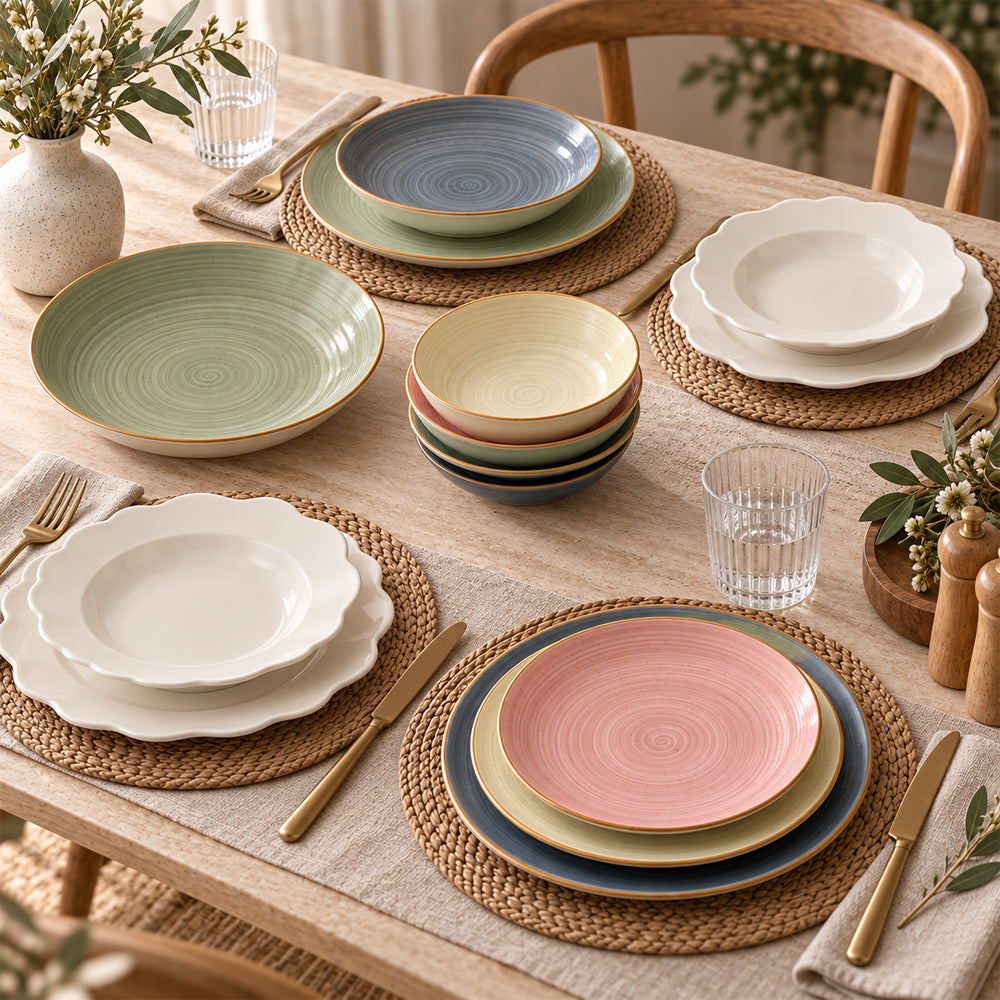
Porcelain or stoneware: which dinnerware set should you choose?
Sooner or later, when you are looking at a new dinnerware set, the question comes up.
Porcelain or stoneware?
And here we are: a clash of titans at the table.
On one side, porcelain: elegant, bright and precise, the kind that always seems to know how to behave, even when guests arrive unexpectedly.
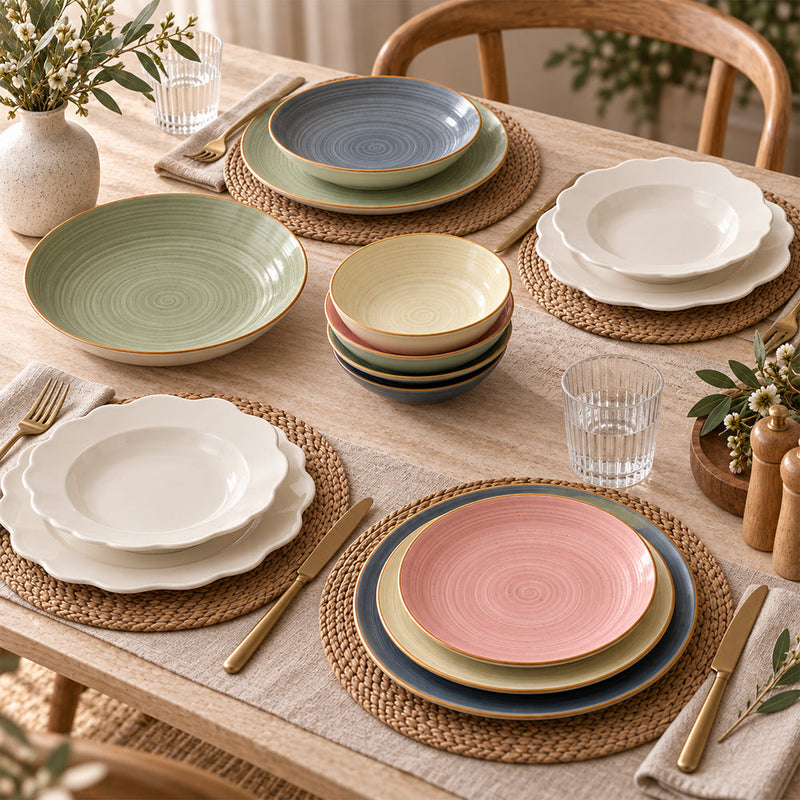
On the other, stoneware: more tactile, colourful and relaxed. The material that can make even a simple plate of tomato pasta look as though it came from a kitchen with lime-plastered walls, a wooden table and a jazz playlist in the background.
But which is the best material for a dinnerware set? The less dramatic but more useful answer is: it depends.
Porcelain and stoneware offer very different characteristics, looks and feelings. Understanding those differences helps you choose not the universally best material, but the one that best suits the way you enjoy your table.
Porcelain or stoneware? Two materials, two distinct personalities. One is all about elegance, the other about character. The pleasure lies in choosing which side you are on.

Porcelain vs stoneware: the differences at a glance
Let us start with the quick answer, the one to keep in mind before getting into the details.
| Feature | Porcelain | Stoneware |
|---|---|---|
| Appearance | Smooth, bright, refined | Tactile, warm, often irregular |
| Style | Classic, elegant, minimalist | Contemporary, Nordic, informal |
| Perceived weight | Usually lighter and thinner | Usually thicker and more substantial |
| Colours and finishes | Often light, uniform or decorated | Ideal for glazes, shades and natural colours |
| Pairing | Very easy to coordinate | Perfect for more distinctive table settings |
| Everyday use | Excellent | Excellent |
The key point is already clear: the main difference between porcelain and stoneware is the character they give to the table.
Porcelain dinnerware: elegance that needs no introduction
Porcelain is one of the materials most closely associated with an elegant table. It has a smooth surface, bright colours, defined edges and a visually lighter presence.
It is the classic material that works with almost anything.
White tablecloth? Fine.
Colourful runner? Fine.
Modern glasses, minimalist cutlery, Sunday lunch with a grandmother checking every detail? Still fine.
A porcelain dinnerware set is especially suitable for anyone looking for:
- a bright, orderly table;
- an elegant style that adapts easily;
- plates that are easy to pair with glasses, cutlery and textiles;
- a set to use both every day and on more formal occasions;
- a clean look that also leaves room for the food presentation.
Porcelain's great advantage is precisely its ability to change personality according to what you place around it.
A white set can look formal with fine stemware and a tablecloth, or thoroughly contemporary with placemats, coloured glasses and simple cutlery.

Porcelain is the option that almost never gets it wrong: bright, clean, easy to combine and perfect when you want an elegant table without overcomplicating things.
Explore the selection of porcelain dinnerware sets directly and compare different shapes, decorations and styles.
Stoneware dinnerware: when the table wants to stand out
Stoneware, often associated with gres, plays a different game.
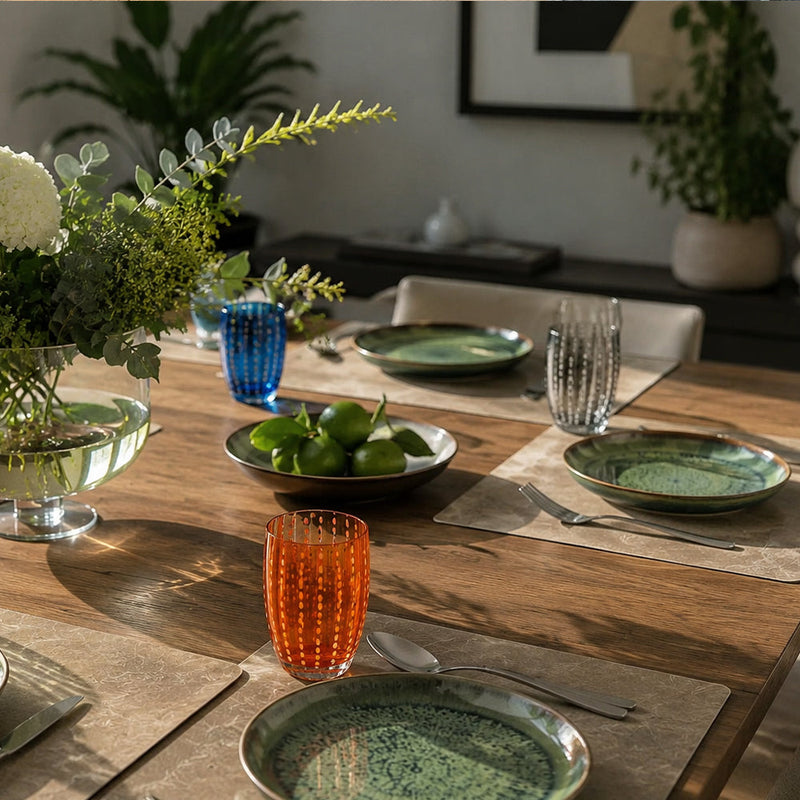
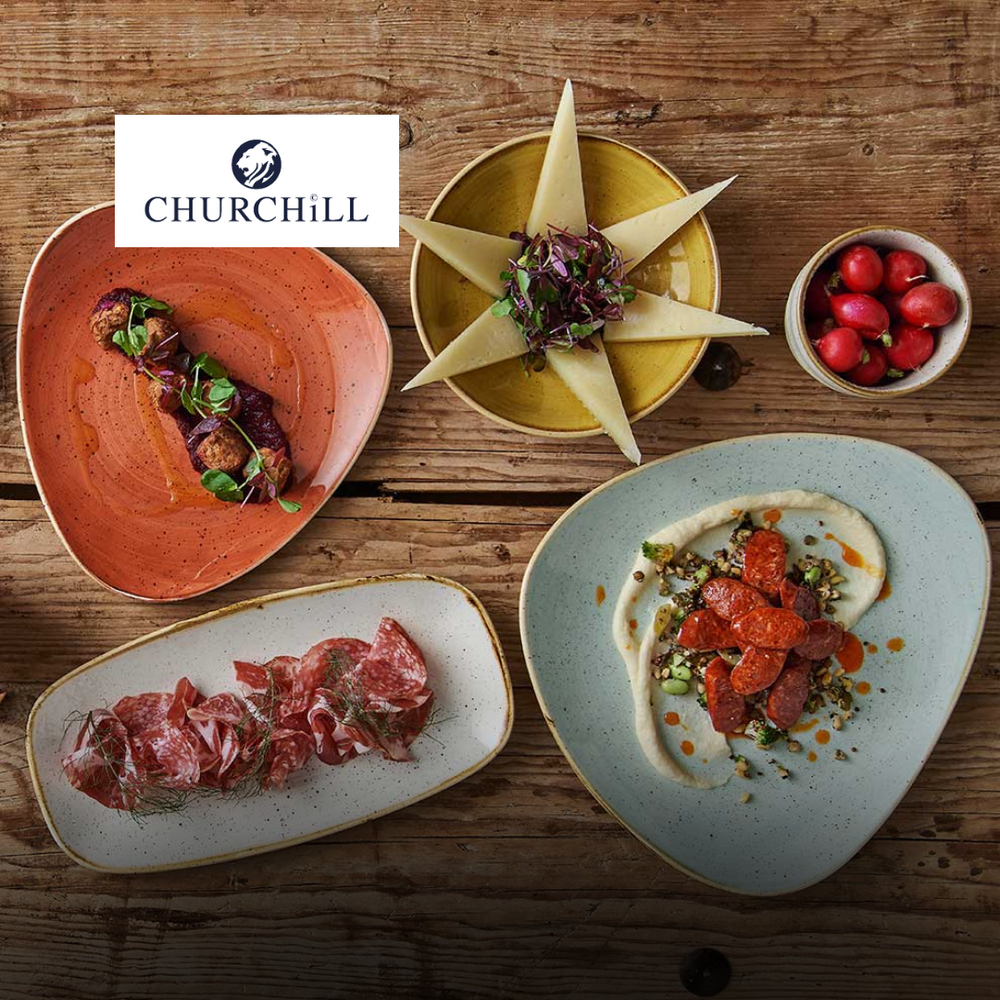
Here, textured surfaces, glazes, colour variations, softer edges and colours that may vary slightly from one piece to another take centre stage.
In other words: less “special-occasion china set”, more “I chose this plate because I genuinely like it”.
A stoneware dinnerware set is particularly suited to those seeking:
- natural or deep colours;
- visible textures and tactile surfaces;
- a contemporary, informal style;
- a table inspired by Nordic, modern rustic or Mediterranean tastes;
- plates that add character even to very simple food.
Stoneware also works beautifully when you want to set the table without a tablecloth, leaving the wood or tabletop visible and using a runner, placemats or just a few accessories.
Pasta, risotto or a simple salad served on a glazed, slightly irregular plate immediately takes on a different presence.

Stoneware does not want to go unnoticed: texture, colour and finishes do half the work before you have even put anything on the plate.
If that is the atmosphere you are looking for, the selection of stoneware and gres dinnerware sets lets you compare different colours, shapes and finishes.
Are stoneware and gres the same thing?
In commercial language, stoneware and gres are often used in very similar ways, especially when discussing dinnerware sets.
Both refer to a compact ceramic fired at high temperatures, generally more tactile in appearance than porcelain.
The actual characteristics may nevertheless vary according to the composition, manufacturing process, thickness and finish chosen by the producer.
For this reason, when buying a set, it is always better to check the specific product information rather than relying only on the material name.
Porcelain or stoneware: which is more durable?
This is probably one of the most searched questions when choosing a new set.
And it is best to avoid turning it into a contest for “the last plate standing after a fall from the table”.
Both porcelain and stoneware can be very durable in everyday use, but their real longevity also depends on the quality of the product, its thickness, the manufacturing process and how it is used.
Porcelain may look thinner and lighter, but that does not automatically mean it is fragile. Stoneware often has a thicker structure and feels more solid, but that does not make it indestructible either.
In other words: neither material is immune to falling onto the floor.
Which material scratches less?
Here too, there is no answer that applies to every set.
Resistance to marks depends on the surface, glaze, finish and even on the cutlery used. Very glossy or particularly light finishes can make small surface marks more visible, while tactile surfaces and irregular colours often disguise them better.
If the set is intended for intensive everyday use, check the maker's care instructions and choose based on your actual habits, not just the photograph.
Porcelain or stoneware for everyday use?
Both can work beautifully as an everyday dinnerware set.
The more useful question is another one: what do you want to see every day when you set the table?
If you prefer a visually light, clean table that is easy to change with glasses and textiles, porcelain is probably the better choice.
If, on the other hand, you want the plates themselves to give the table instant personality, stoneware has the advantage.
Which should you choose for an elegant table?
If “elegant” means white, clean proportions, fine stemware and a more formal table to you, porcelain is the most immediate choice.
But be careful: elegant does not necessarily mean classic.
Dark stoneware, well paired with understated cutlery and fine glasses, can create an extremely refined, contemporary table.
The very idea of table elegance has changed: today, the coherence of the whole matters far more than the formality of a single element.

Elegant does not have to mean classic: with clean shapes and the right pairings, porcelain can be thoroughly modern without making too much noise.
Stoneware or porcelain for a modern table?
Here, stoneware is definitely playing at home.
Natural colours, sage green, beige, grey, deep blue, reactive glazes and irregular rims have become recurring features of contemporary tables.
But porcelain can also look extremely modern when it leaves behind classic decoration and focuses on crisp geometry, organic shapes or solid colours.
So yes, stoneware starts as the favourite. But the contest is far from over.
Dishwasher and microwave: what changes?
Many modern porcelain and stoneware sets are designed for everyday use and may be dishwasher- and microwave-safe.
That should not be assumed automatically, however.
Decoration, metallic finishes, special glazes and particular manufacturing techniques can change the conditions of use. Always check the producer's instructions for the individual set.
If you use the dishwasher and microwave frequently, this should be among your first selection criteria.
Porcelain vs stoneware: which best enhances food?
Now we are entering presentation territory.
White porcelain creates a neutral base that easily highlights the colours and shapes of the dish.
Stoneware, on the other hand, plays a more active role in the visual composition. A dark, green, sand-coloured or blue surface can create interesting contrasts and a more contemporary feel.
It can be simplified like this:
- Do you want the plate to almost disappear and let the food speak? Porcelain.
- Do you want the serving piece itself to be part of the presentation? Stoneware.
And terracotta? An honourable mention
While porcelain and stoneware compete for the title, someone is sitting a little way off with no need at all to join the contest: terracotta.
It has an entirely different identity, immediately associated with a warm, Mediterranean, rustic and convivial table.
Earthy colours, natural surfaces and a very distinctive presence make it interesting for anyone wanting a deliberately less formal table.
It is not the neutral alternative to the other two. It is a precise aesthetic choice.
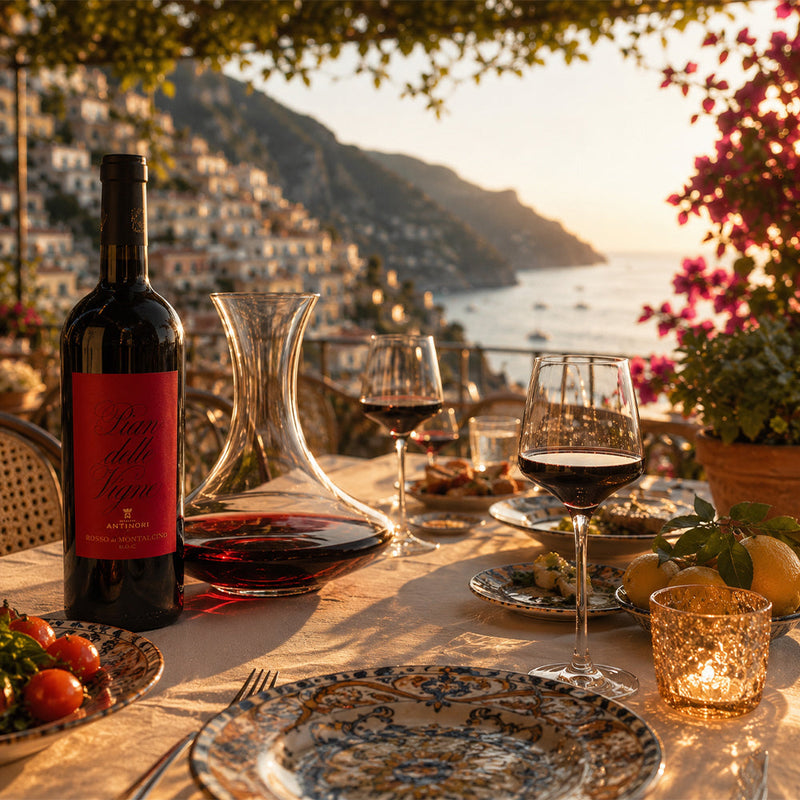
Porcelain and stoneware are debating which is more elegant. Meanwhile, terracotta has already set the table outside, opened a bottle of wine and put the bread in the centre.
Porcelain, stoneware or terracotta: a quick comparison
| Material | Predominant style | Effect on the table | Ideal for |
|---|---|---|---|
| Porcelain | Elegant, minimalist, classic | Bright and orderly | Those seeking maximum versatility |
| Stoneware / gres | Contemporary, tactile | Warm and distinctive | Those who want plates to be the focal point |
| Terracotta | Rustic, Mediterranean | Natural and convivial | Those seeking a very distinct identity |
How to choose the right dinnerware set
To choose well, do not start with the material alone. Start with your habits.
Ask yourself:
- Will I use it every day, or mainly when I have guests?
- Do I prefer a minimalist or a more decorative table?
- Do I always use the dishwasher?
- Do I want to change the look easily with glasses and textiles?
- Do I prefer visually light plates or more substantial ones?
- Do I like uniform surfaces, or textures and colour variations?
The answers make the choice far simpler than any ranking.
Is a complete set better, or mix and match?
Here, we can finally let go of an old rule: not everything has to match perfectly.
A complete set remains the easiest choice if you want an immediately tidy result. But combining different plates can create a much more personal table.
You might use stoneware dinner plates and small porcelain plates, for instance, or keep the main set neutral and introduce colour through serving dishes and accessories.
The important thing is to retain at least one shared element: colour, shape, material or style.
Porcelain or stoneware: which should you choose in the end?
Let us keep it simple.
Choose porcelain if:
- you want a versatile set;
- you love bright, orderly tables;
- you prefer an elegant or minimalist style;
- you want to change the look easily through accessories and textiles.
Choose stoneware if:
- you love colour, texture and tactile surfaces;
- you prefer a modern, informal table;
- you want your plates to have a strong aesthetic presence;
- you enjoy creating table settings with a more personal character.
Choose terracotta if: you have read all of this while thinking that what you really wanted was simply a warm, Mediterranean table without too much ceremony.
Frequently asked questions about porcelain and stoneware
What is the difference between porcelain and stoneware?
Porcelain generally has a smoother, brighter and more refined surface. Stoneware tends to have more visual weight, more tactile texture and finishes marked by glazes and colour variation.
Is a porcelain or stoneware dinnerware set better?
There is no universally better material. Porcelain is especially versatile and elegant, while stoneware is ideal for anyone seeking a contemporary, tactile table. The choice depends mainly on style and habits of use.
Is stoneware durable?
Stoneware is commonly used for sets intended for everyday use as well. Its actual durability still depends on quality, thickness, manufacturing and the individual producer's instructions.
Is porcelain fragile?
Porcelain can be thin and light without necessarily being fragile. Products intended for everyday use are designed to be used regularly, but like any ceramic they can chip or break after a significant impact.
Are stoneware and gres the same thing?
The terms are often used similarly in the tableware sector, but composition, firing and specific characteristics can vary between makers and collections. It is therefore useful to check the details of each product.
Can porcelain and stoneware go in the dishwasher?
Many sets are dishwasher-safe, but that is not a universal rule. Particular decoration and finishes may need specific care, so always check the producer's instructions.
Can porcelain and stoneware go in the microwave?
Many models are microwave-safe, but metal decoration, glazes or special finishes can make a difference. Always check the producer's specific information before use.
Which material should you choose for a modern table?
Stoneware is especially appreciated for contemporary tables thanks to its colours, textures and tactile finishes. Porcelain can also look very modern when it has simple shapes and minimal decoration.
Which dinnerware set should you choose for everyday use?
Both porcelain and stoneware can be suitable for everyday use. Porcelain is right for those seeking visual lightness and versatility, while stoneware is interesting for anyone wanting a more tactile, distinctive set.
Which dinnerware set should you choose for an elegant table?
Porcelain is the most immediate choice for an elegant, bright and versatile table. Stoneware can nevertheless create an equally refined result when colours, glasses, cutlery and textiles are balanced well.
A dinnerware set says more than you think
In the end, all plates are for eating from.
That is their purpose. There is not much we can do about it.
But a white porcelain plate, a deep-blue stoneware plate and an earth-coloured terracotta plate do not tell the same story at all.
That is where the choice becomes interesting.
You are not simply deciding what to serve dinner on. You are choosing the atmosphere you want to create every time you set the table.
If you love brightness and versatility, start with porcelain dinnerware sets. If you prefer texture and character, explore stoneware and gres sets. And if neither has convinced you because you were looking for something even warmer and more natural, there is always the terracotta selection.
The clash of titans, then, ends without a winner.
Which is probably for the best: that way, we can keep buying plates without feeling guilty.
Porcelain or stoneware? The real mistake is choosing what you think you “should” buy rather than what you would want to see on your table every day.