


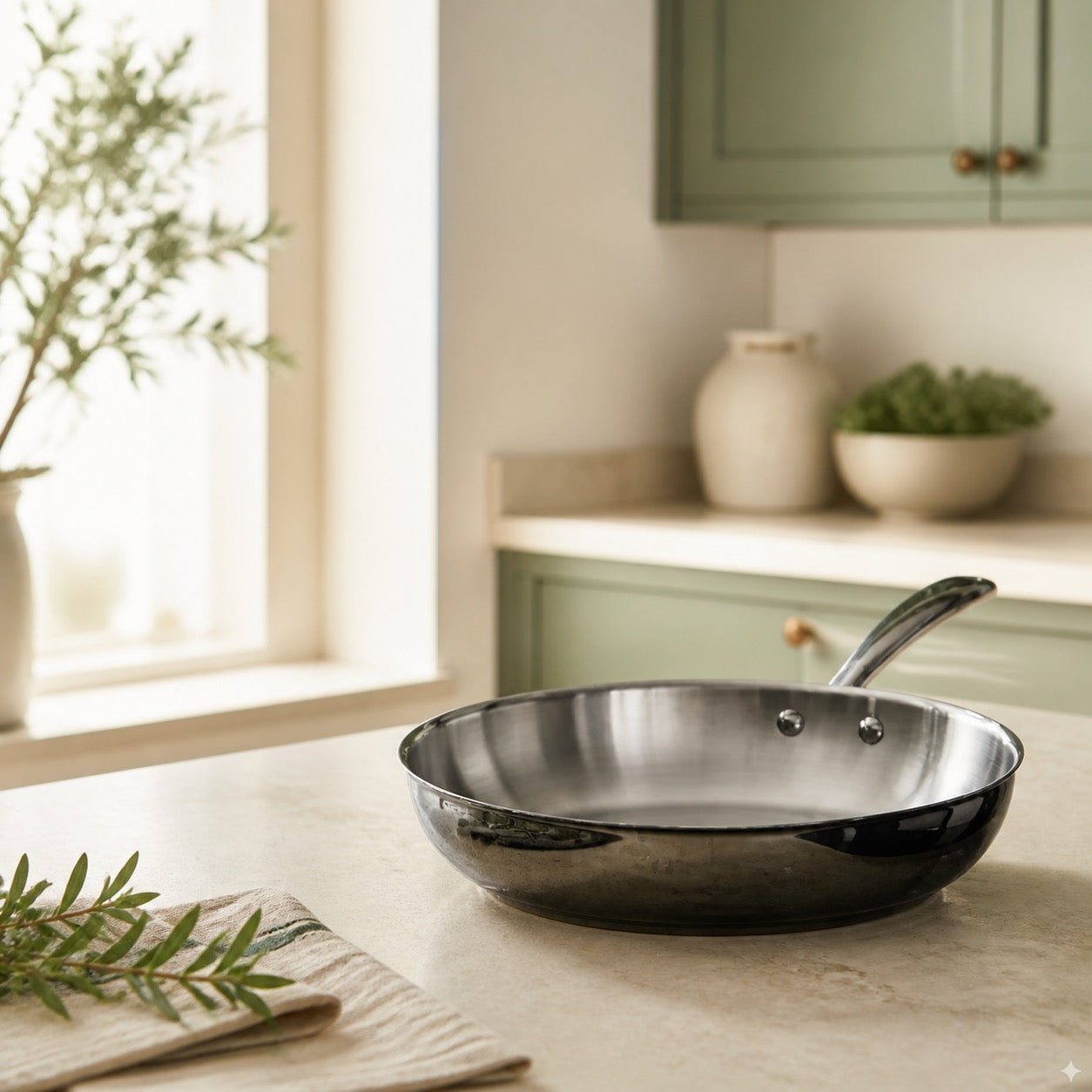
Stainless steel, aluminium or non-stick: which frying pan should you choose?
Choosing a stainless steel, aluminium or non-stick frying pan does not mean deciding which material is absolutely the best. It means understanding which tool best suits the dishes you cook most often, the type of hob you use and the level of control you want during cooking.
All frying pans can cook meat, fish, vegetables or eggs. However, they do not all do it in the same way. They differ in how quickly they reach temperature, how evenly they distribute heat, their ability to brown food and how easy they are to use and clean.
A stainless steel frying pan can produce intense browning and rich pan juices. Aluminium responds quickly to changes in heat and distributes it evenly. A non-stick coating, on the other hand, makes delicate foods easier to cook and allows you to use less fat.
The right question, therefore, is not which frying pan is the best on the market, but which frying pan to choose for the way you cook.
Frying pans for every type of cooking
Compare materials, diameters and compatible bases to find the frying pan best suited to your everyday cooking.
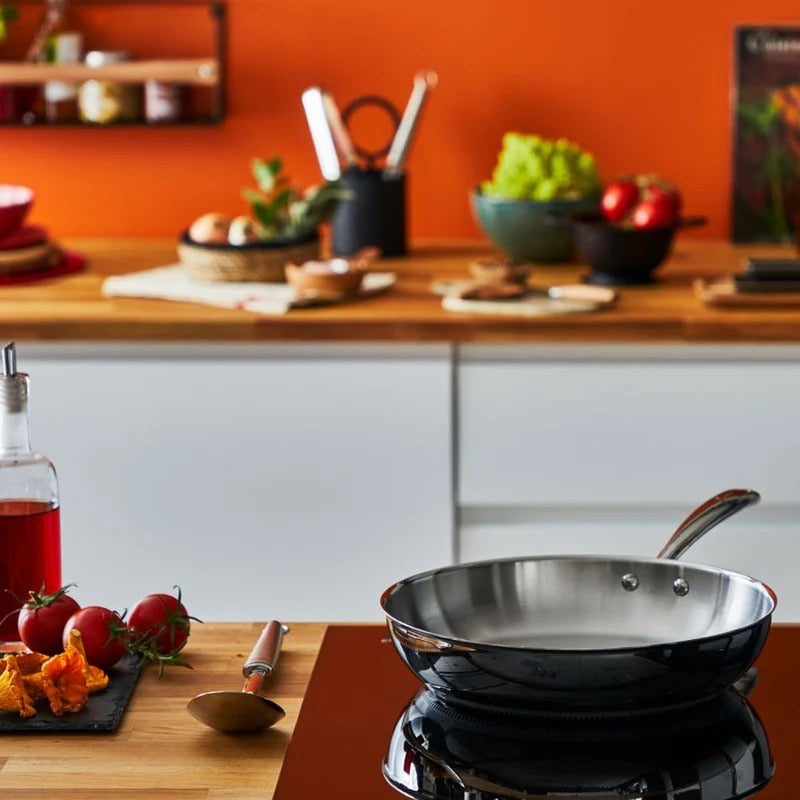
How to choose the material of your frying pan
To choose the right frying pan material, you need to consider five factors: heat conduction, cooking temperature, type of food, maintenance and compatibility with your hob.
If you often cook meat, sautéed vegetables and dishes that require high temperatures, you may prefer stainless steel. If you want speed and control, aluminium may be the better choice. For eggs, omelettes, pancakes and delicate fish, a non-stick coating is generally easier to manage.
Personal experience also matters. A stainless steel frying pan requires proper management of preheating and fats. A non-stick model is more immediate, but it must be used with utensils and temperatures that are compatible with the coating.
| Material | Main strength | Ideal for | Main consideration |
|---|---|---|---|
| Stainless steel | Browning and durability | Meat, fish, vegetables and pan sauces | Requires control of temperature and fats |
| Aluminium | Speed and heat distribution | Quick cooking, sauces, sautéing and frequent use | Compatibility depends on the base construction |
| Non-stick | Ease of use and food release | Eggs, omelettes, pancakes, fish and delicate cooking | Must not be overheated or scratched |
Stainless steel frying pans: features and uses
Stainless steel frying pans are valued for their durability, long lifespan and ability to work at medium-high temperatures. Stainless steel is not naturally non-stick: the result depends on correct preheating, the amount of fat used and how the food is handled.
This makes stainless steel less immediate than a non-stick coating, but very effective when you want to achieve a well-browned surface. The reaction between the food and the bottom of the pan creates caramelised residues that can be deglazed with wine, stock or water to prepare sauces and pan juices.
Stainless steel is also relatively non-reactive and can be used with acidic ingredients such as tomatoes, wine, lemon and vinegar. This makes it suitable for a wide range of dishes, from escalopes to sautéed vegetables.
When to choose a stainless steel frying pan
- For browning meat, fillets and burgers.
- For sautéing vegetables at high temperatures.
- For preparing pan juices and sauces.
- For cooking with acidic ingredients.
- For using durable utensils on an uncoated surface.
- For a frying pan intended for intensive and prolonged use.
Advantages of stainless steel frying pans
- Durability: withstands frequent use and high temperatures.
- Versatility: suitable for many foods and cooking techniques.
- Browning: promotes the formation of crusts and golden surfaces.
- Maintenance: there is no non-stick coating that needs protecting.
- Acidic ingredients: can be used with tomatoes, wine and citrus fruits.
Limitations of stainless steel frying pans
Stainless steel does not conduct heat as quickly as aluminium. For this reason, many frying pans use multi-layer bases or inner layers made from more conductive materials.
Food can also stick when the pan is too cold, too hot or contains too little fat. Learning to recognise the correct temperature is therefore essential.
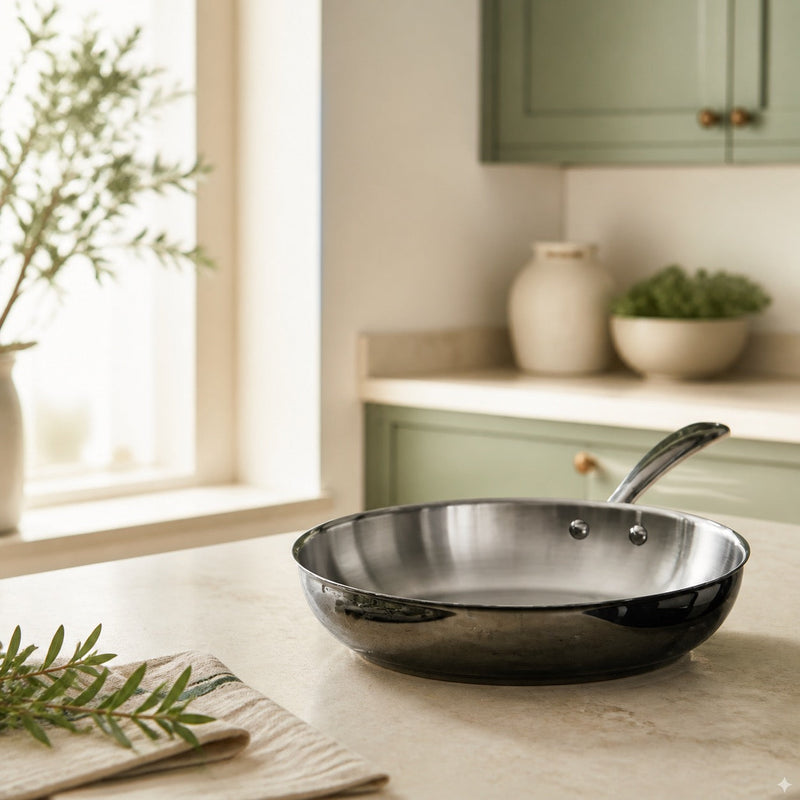
Stainless steel frying pans
Ideal for browning, pan sauces and dishes that require a durable surface and sustained temperatures.
How to prevent food from sticking to a stainless steel frying pan
To prevent food from sticking to a stainless steel frying pan, preheat the base correctly, add the fat only after heating and use food that is dry and not excessively cold.
Once placed on the hot surface, meat may initially stick. When browning is complete, it tends to release more easily. Trying to turn it too early can break the crust and leave part of the food stuck to the base.
Practical method for using stainless steel
- Heat the empty pan over medium heat.
- Add oil, clarified butter or another suitable fat.
- Spread the fat over the surface.
- Dry the food before placing it in the pan.
- Wait for browning to develop before turning it.
- Reduce the heat when necessary to finish cooking.
The water-drop test can provide an approximate indication of preheating, but it does not replace experience and should be used with caution. Before adding fat, all water must be completely removed from the pan.
Aluminium frying pans: why they are used in professional kitchens
Aluminium frying pans are lightweight, easy to handle and able to distribute heat quickly. Their most important characteristic is not simply their low weight, but the speed with which they respond to changes in the heat source.
When the flame is increased or reduced, an aluminium frying pan changes temperature quickly. This behaviour makes it possible to control quick cooking, sautéing, sauces and dishes that require immediate adjustments with precision.
Thickness is a key factor. A thin frying pan heats very quickly, but it can create hotter areas and deform more easily. A thicker body retains heat more effectively, provides greater uniformity and still remains easy to handle.
When to choose an aluminium frying pan
- For frequent cooking and handling many dishes in succession.
- For sautéing pasta, vegetables and ingredients cut into small pieces.
- For quickly controlling cooking intensity.
- For reducing the weight of the pan during use.
- For cooking evenly across the entire surface.
Advantages of aluminium frying pans
- Heat conduction: heat is distributed quickly.
- Responsiveness: the pan reacts quickly to heat adjustments.
- Lightweight: makes tossing and frequent movement easier.
- Professional use: suitable for intensive workloads.
- Variety: available uncoated, coated or with induction-compatible bases.
Limitations of aluminium frying pans
Uncoated aluminium should be used according to the manufacturer's instructions, especially with acidic or highly salted foods left in the pan for long periods. Coated or treated models may have different characteristics.
Not all aluminium frying pans are automatically compatible with induction. To work on this type of hob, they must have a specific ferromagnetic base.
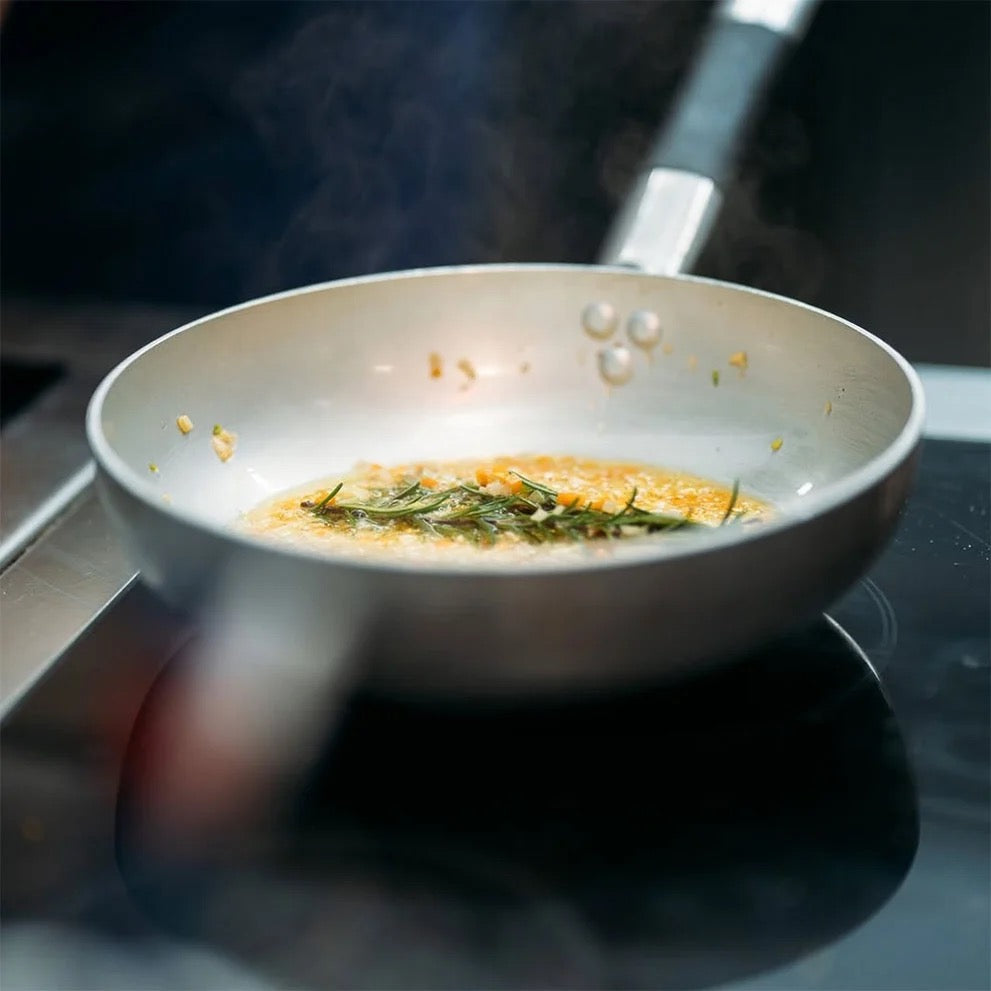
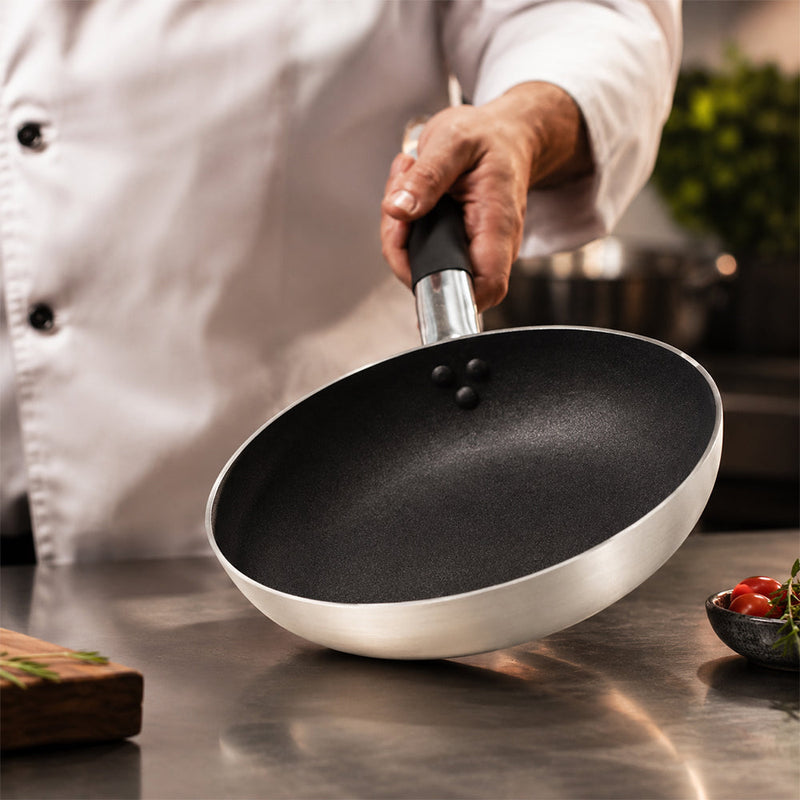
Aluminium frying pans
Lightweight and responsive, they distribute heat quickly and allow you to adjust the temperature during cooking.
Uncoated aluminium or coated aluminium?
An uncoated aluminium frying pan has the metal directly in contact with the food and is chosen mainly for its heat conduction, lightness and immediate response to heat. However, it requires informed use and maintenance in line with the manufacturer's instructions.
A coated aluminium frying pan combines the thermal conductivity of the body with the practicality of a non-stick surface. This combination is very common because it offers even heating and ease of use.
The term aluminium therefore describes the material of the body, while non-stick refers to the characteristic of the inner surface. A frying pan can be both aluminium and non-stick at the same time.
Non-stick frying pans: how they work
Non-stick frying pans have a coating designed to reduce food sticking to the surface. The underlying body may be made from aluminium, steel or a multi-layer construction.
The coating makes delicate cooking easier and generally allows smaller amounts of oil or butter to be used. It is particularly useful when food needs to retain its shape and integrity when released from the pan.
A non-stick frying pan should not, however, be considered suitable for every temperature. Overheating an empty pan can progressively damage the coating and reduce its performance.
When to choose a non-stick frying pan
- For cooking eggs, omelettes and frittatas.
- For preparing pancakes, crêpes and delicate batters.
- For cooking fish fillets and fragile foods.
- For using a moderate amount of fat.
- For making everyday cleaning easier.
- For dishes cooked at low or medium temperatures.
Advantages of non-stick frying pans
- Ease of use: require less experience when it comes to releasing food.
- Delicate cooking: help keep foods intact.
- Less fat: allow you to reduce oil and butter when the recipe permits.
- Cleaning: residues are generally easy to remove.
- Everyday use: practical for quick preparations.
Limitations of non-stick frying pans
The non-stick coating is subject to wear. Metal utensils, abrasive sponges, overheating and stacking without protection can scratch or damage the surface.
These frying pans are also not the best choice for achieving aggressive browning or a very intense crust. For these techniques, a stainless steel or iron surface is generally more suitable.
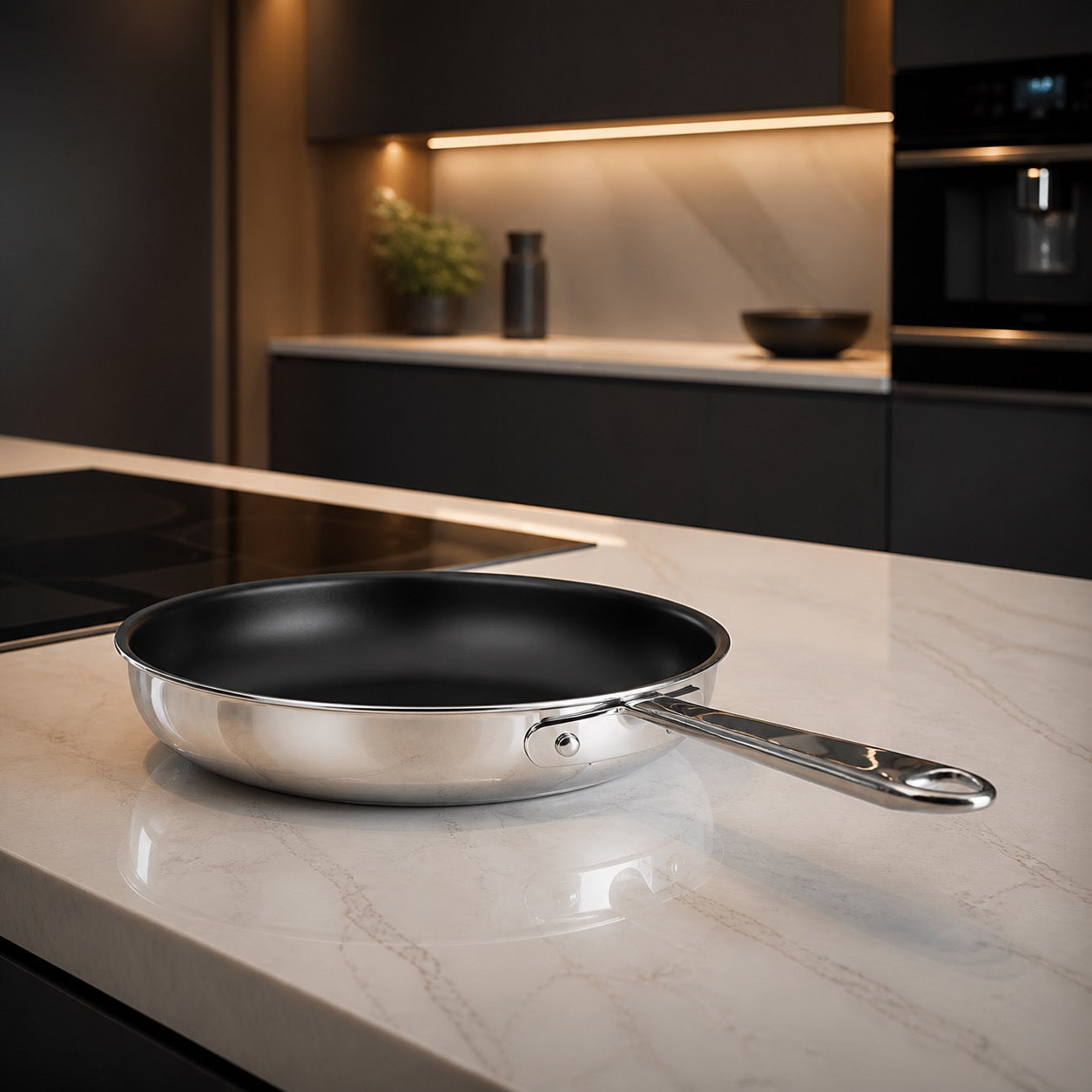
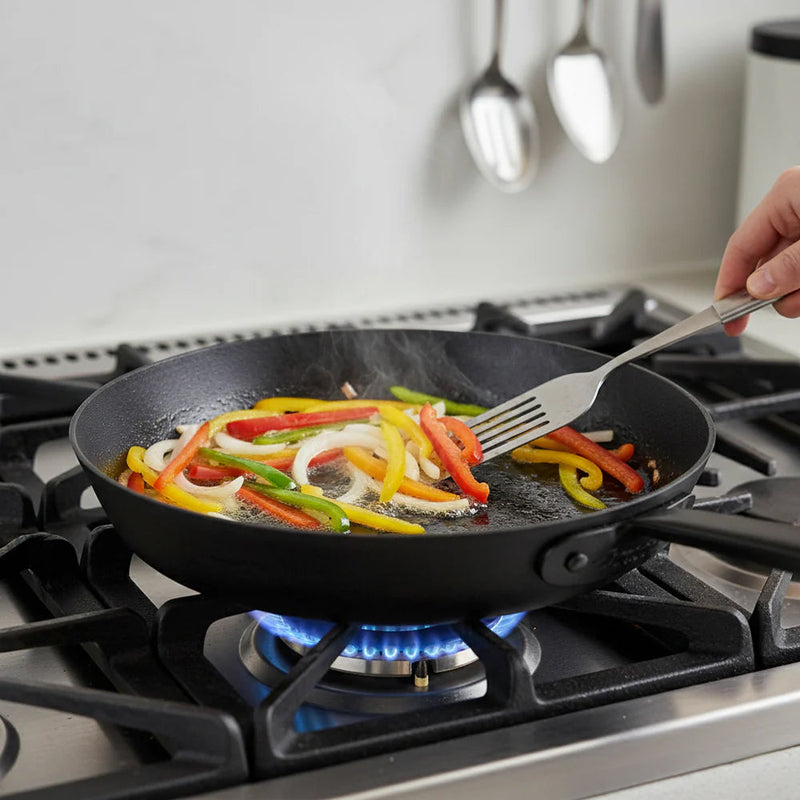
Non-stick frying pans
Suitable for eggs, pancakes, fish and delicate dishes that require easy food release and quick cleaning.
How to use a non-stick frying pan correctly
To extend the life of a non-stick frying pan, it is advisable to use it at low or medium temperatures, avoid prolonged empty preheating and choose utensils made from wood, silicone or other compatible materials.
When cleaning, it is best to wait for the pan to cool down. Moving a very hot surface directly under cold water can subject the body to thermal shock and encourage deformation.
Practical rules for protecting the coating
- Do not heat the empty pan for long periods.
- Use low or medium temperatures.
- Avoid knives, forks and metal utensils.
- Do not cut food directly in the pan.
- Use soft sponges and non-abrasive detergents.
- Use a protective layer when stacking frying pans.
- Replace the product when the coating is deeply scratched or damaged.
Stainless steel or non-stick: which should you choose?
The choice between a stainless steel or non-stick frying pan depends mainly on the type of cooking. Stainless steel is suitable for browning, high temperatures and pan sauces. Non-stick is better suited to delicate foods and preparations that need to release easily.
| Requirement | Stainless steel | Non-stick |
|---|---|---|
| Searing a steak | Recommended | Less suitable |
| Cooking a frittata | Requires experience | Recommended |
| Preparing a sauce from pan juices | Recommended | Less effective |
| Cooking delicate fish | Possible with the correct technique | Recommended |
| Using high temperatures | Suitable | Should be limited |
| Quick cleaning | May require soaking | Generally easier |
In a well-equipped kitchen, the two materials are not alternatives but complementary tools. A stainless steel frying pan and a non-stick frying pan allow you to handle very different dishes without forcing one tool to perform tasks it was not designed for.
Stainless steel or aluminium: what are the differences?
Stainless steel is durable, relatively non-reactive and suitable for browning. Aluminium is lighter and conducts heat more quickly. However, the difference you experience in use also depends on thickness, base and pan construction.
A stainless steel frying pan with a multi-layer base can distribute heat more evenly than a simple model. A thick aluminium frying pan can retain heat effectively and provide very stable performance.
| Feature | Stainless steel | Aluminium |
|---|---|---|
| Weight | Generally heavier | Generally lighter |
| Heating speed | Depends on the base | Fast |
| Response to heat changes | More gradual | Very fast |
| Browning | Very effective | Depends on the surface and treatment |
| Ease of handling | Variable | Generally high |
| Acidic ingredients | Suitable | Check treatment and instructions |
Aluminium or non-stick: they are not always alternatives
Aluminium and non-stick are often compared as though they were two alternative materials. In reality, many non-stick frying pans have a coated aluminium body.
Aluminium defines the thermal behaviour of the body of the pan. The non-stick coating, on the other hand, describes the surface that comes into contact with the food. A frying pan can therefore combine the conductivity of aluminium with the practicality of a non-stick coating.
Before purchasing, it is useful to check not only whether a coating is present, but also the thickness of the body, construction of the base and compatibility with heat sources.
Which material should you choose for each type of cooking?
| Preparation | Recommended material | Reason |
|---|---|---|
| Steak and burgers | Stainless steel | Promotes browning and crust formation |
| Eggs and omelettes | Non-stick | Reduces sticking and makes food easier to release |
| Delicate fish | Non-stick | Helps keep the fillet intact |
| Sautéed vegetables | Stainless steel or aluminium | Allow quick cooking at sustained temperatures |
| Sautéed pasta | Aluminium | It is lightweight and responds quickly to heat |
| Pancakes and crêpes | Non-stick | Makes turning and releasing the batter easier |
| Tomato sauces | Stainless steel | Suitable for acidic ingredients |
| Sauces and reductions | Stainless steel or coated aluminium | Provide temperature control |
Induction frying pans: material alone is not enough
An induction frying pan must have a base capable of interacting with the magnetic field generated by the hob. The material of the pan body alone does not determine compatibility.
Some stainless steel frying pans work directly on induction, while other alloys are not magnetic. Aluminium frying pans and many non-stick models generally require a ferromagnetic disc integrated into the base.
Before buying, you should therefore look for an explicit indication of induction compatibility. The simple fact that a frying pan is made from stainless steel, aluminium or has a non-stick coating is not sufficient guarantee.
How to check induction compatibility
- Check for the induction symbol on the packaging or product page.
- Check the heat sources declared by the manufacturer.
- Make sure the base is flat and proportionate to the cooking zone.
- Do not rely solely on the material stated in the product name.
A magnet test can provide an initial indication: if it sticks firmly to the base, the frying pan may be compatible. Final confirmation, however, should always be based on the manufacturer's specifications.
How important is frying pan thickness?
Thickness affects heat distribution, stability and retention. A thin frying pan heats up quickly, but it can create hot spots and lose temperature when cold food is added.
A thicker frying pan takes longer to reach temperature, but tends to distribute and retain heat better. This can be useful for browning, even cooking and professional use.
There is no ideal thickness for every type of preparation. For quick cooking and frequent movement, a lightweight, responsive pan may be useful. For meat and stable cooking, a more substantial base is often preferable.
How to choose the diameter of a frying pan
The diameter should be chosen according to the number of people, quantity of food and size of the cooking zone. A frying pan that is too small forces ingredients to overlap and encourages steaming rather than browning.
A frying pan that is too large for the burner may instead heat unevenly, especially on induction hobs where the cooking zone is smaller than the base.
| Approximate diameter | Use | Approximate servings |
|---|---|---|
| 20 cm | Eggs, sauces and small portions | 1 person |
| 24 cm | Everyday dishes and side dishes | 1-2 people |
| 26 cm | Meat, fish, frittatas and vegetables | 2-3 people |
| 28 cm | Complete dishes and family portions | 3-4 people |
| 30-32 cm | Large quantities and shared dishes | 4 or more people |
The serving sizes are approximate and depend on the type of food. For proper browning, it is better to leave space between ingredients rather than completely filling the surface.
Which frying pan should you buy first?
To build a versatile cookware collection, it is better to choose several complementary tools rather than searching for one frying pan that can do everything.
A 24 or 26 centimetre non-stick frying pan covers eggs, frittatas, fish and delicate cooking. A 26 or 28 centimetre stainless steel frying pan allows you to brown meat and vegetables and prepare pan sauces.
If you often sauté pasta, vegetables or quick dishes, you can add an aluminium frying pan, choosing the diameter according to your usual portions and checking compatibility with your hob.
Essential two-pan set
- One non-stick frying pan: for eggs, fish, crêpes and delicate cooking.
- One stainless steel frying pan: for meat, browning, vegetables and sauces.
Complete three-pan set
- Stainless steel: for high temperatures and pan sauces.
- Aluminium: for speed, lightness and frequent cooking.
- Non-stick: for simplicity and delicate foods.
The most versatile pair
A stainless steel frying pan for browning and a non-stick pan for delicate cooking cover most everyday needs.
Mistakes to avoid when choosing a frying pan
- Looking for one material for everything: each surface delivers different results.
- Considering price alone: construction, thickness and base affect everyday use.
- Ignoring the hob: not all frying pans work on induction.
- Choosing a diameter that is too small: crowded food releases steam and browns less effectively.
- Confusing aluminium with non-stick: the former may be the body material, while the latter is a coating.
- Using non-stick at high temperatures: the coating must be protected from overheating.
- Rejecting stainless steel because food sticks: temperature management is often the real issue.
- Considering weight alone: a more substantial construction can provide greater thermal stability.
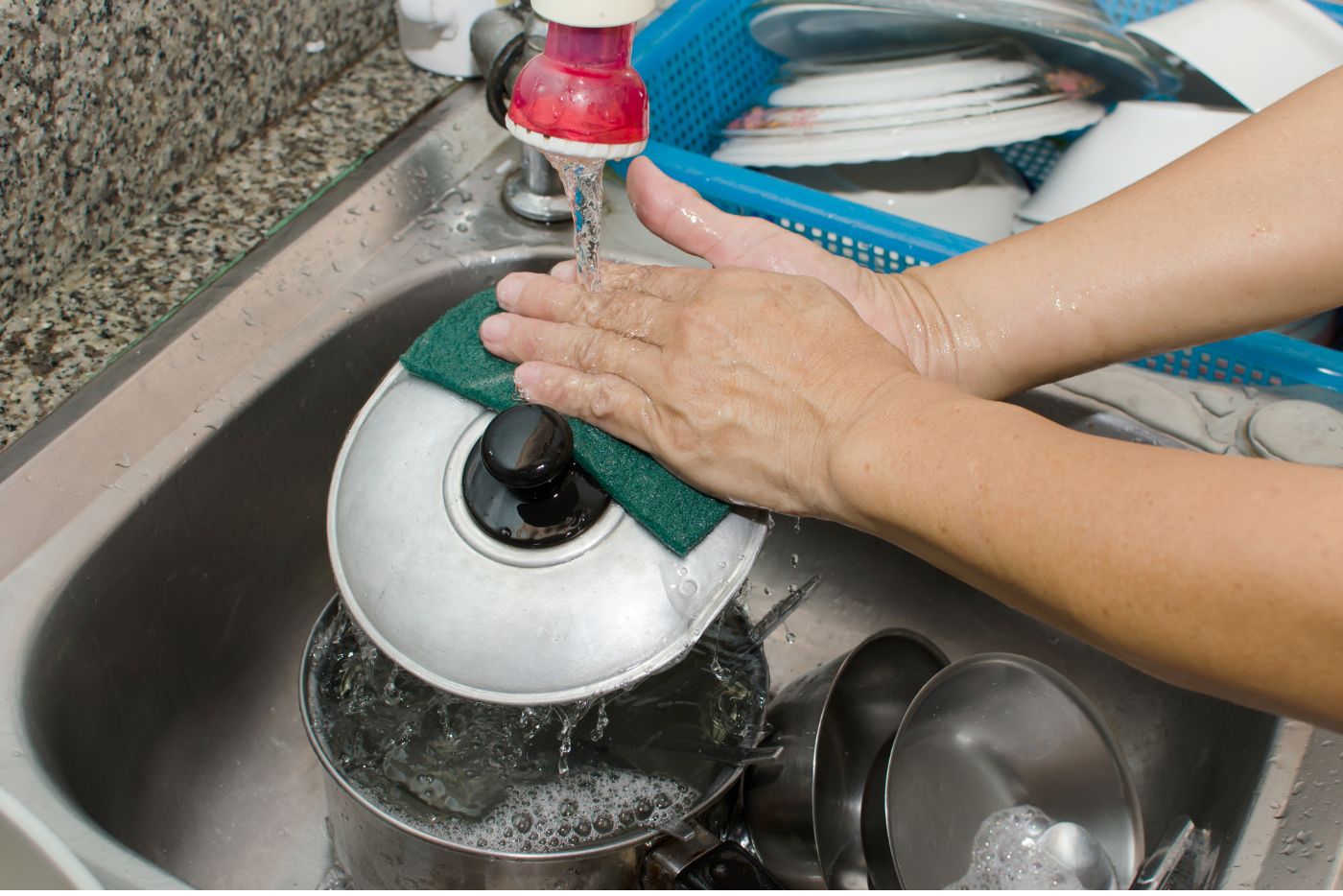
How to clean frying pans according to material
Cleaning stainless steel frying pans
A stainless steel frying pan can be left to cool and washed with hot water and detergent. More stubborn residues can be softened by adding water while the pan is still warm or by briefly deglazing it.
Before using abrasive products, it is advisable to check the manufacturer's instructions, especially if the pan has special exterior finishes.
Cleaning aluminium frying pans
Cleaning methods depend on the surface treatment. Uncoated, anodised and coated aluminium may require different care. It is therefore necessary to follow the specific product instructions.
Aggressive detergents and unsuitable washing methods can alter the appearance of the material or damage any coatings.
Cleaning non-stick frying pans
The non-stick surface should be washed with soft sponges and non-abrasive detergents. Before washing, it is best to wait until the pan has lost most of its heat.
Dishwasher compatibility should be checked for the individual model. Even when dishwasher use is permitted, hand washing can help preserve the coating for longer.
Stainless steel, aluminium or non-stick: which frying pan is worth choosing?
A stainless steel frying pan is ideal for those who want durability, intense browning and technical control. Aluminium is suitable for those looking for lightness, rapid heat distribution and immediate response. Non-stick is the most practical choice for delicate cooking and everyday use.
The value of a frying pan does not depend only on the material stated. Thickness, base, shape, handle, coating and build quality determine the real cooking experience.
For this reason, two frying pans made from the same material can behave very differently. The choice should consider the entire product rather than a single feature listed in the technical specifications.
A different frying pan for every way of cooking
There is no perfect material for every recipe. There are tools designed to offer different advantages.
Stainless steel requires more attention, but delivers browning and pan sauces that are difficult to achieve with a coating. Aluminium offers speed and easy handling. Non-stick simplifies more fragile preparations and everyday cooking.
The most versatile solution often consists of combining at least two frying pans: one resistant to high temperatures and one dedicated to delicate cooking. This allows each recipe to be approached with the right tool, without asking a single surface to perform incompatible tasks.
You can compare materials, sizes and features in Alberoshop.it's selection of kitchen frying pans, always checking diameter, compatible heat sources and maintenance instructions.
Choose according to how you cook
Stainless steel for browning, aluminium for quickly controlling heat and non-stick for more delicate preparations.
Frequently asked questions about stainless steel, aluminium and non-stick frying pans
Is a stainless steel, aluminium or non-stick frying pan better?
It depends on the preparation. Stainless steel is suitable for browning and high temperatures, aluminium for speed and heat distribution, while non-stick is better suited to eggs, fish and delicate foods.
What is the best material for a frying pan?
There is no single best material. The choice depends on the type of cooking, heat source, required maintenance and the cook's level of experience.
Why does food stick to a stainless steel frying pan?
Food can stick when the pan has not been preheated correctly, there is too little fat or the food is turned before browning has developed.
Which frying pan should you use for meat?
For steaks, burgers and meat that needs browning, a stainless steel frying pan is recommended. The surface can reach high temperatures and promotes crust formation.
Which frying pan should you use for eggs?
For eggs, omelettes and frittatas, a non-stick frying pan is generally recommended. The coating makes food easier to release and allows a moderate amount of fat to be used.
Which frying pan should you use for fish?
For delicate fillets, a non-stick frying pan is useful. Fish with firmer skin can also be cooked in stainless steel, provided the surface is properly preheated.
Are aluminium frying pans non-stick?
Not necessarily. Aluminium describes the material used for the body of the frying pan. To be non-stick, a specific coating must be applied to the inner surface.
Do aluminium frying pans work on induction?
Only if they have a compatible ferromagnetic base. The presence of aluminium alone is not enough: you need to check the induction symbol or the manufacturer's specifications.
Do all stainless steel frying pans work on induction?
No. Compatibility depends on the composition and construction of the base. You must check that the manufacturer explicitly states that the frying pan is suitable for induction hobs.
Can non-stick frying pans be used at high temperatures?
Non-stick frying pans are generally intended for low or medium temperatures. Excessively high temperatures and prolonged empty preheating can damage the coating.
When should you replace a non-stick frying pan?
It is advisable to replace it when the coating shows deep scratches, raised areas, peeling or a clear loss of non-stick performance.
Which frying pan should you choose for everyday cooking?
For everyday use, a good-quality non-stick frying pan is practical. For a more complete setup, it is useful to pair it with a stainless steel model for meat, vegetables and browning.
What frying pan diameter should you choose for two people?
For two people, 24 or 26 centimetre frying pans are generally suitable. However, the correct size depends on the type of food and the amount of space required for browning.
Which frying pans do you really need in the kitchen?
An essential setup includes a non-stick frying pan for delicate cooking and a stainless steel frying pan for browning and high temperatures. An aluminium model can complete the set for sautéing and quick preparations.
Where can you buy stainless steel, aluminium and non-stick frying pans?
You can compare stainless steel, aluminium and non-stick frying pans on Alberoshop.it, choosing the model according to diameter, material, induction compatibility and intended use.