
Iron Pans: Complete Guide to Use, Care and Choosing the Right One
Iron pans are back in home kitchens because they do one very simple thing: they cook well. They do not promise magic, they do not have delicate coatings to treat with anxiety, and they do not try to be “easy” at all costs. They are practical, robust tools designed for browning, frying, sautéing and creating that crust that a standard non-stick pan often cannot deliver.
Iron is a direct material: it heats up, reacts, transfers heat decisively and, with use, develops a natural patina that progressively improves cooking performance. This is why iron pans are loved by chefs, enthusiasts and anyone who wants to cook meat, vegetables, eggs, crêpes and fried foods with greater control.
In this guide, we look at how to use an iron pan, how to create the patina, which cooking methods it enhances best, how to clean it and when to choose it over non-stick pans, stainless steel or cast iron. To compare sizes and models, you can explore the selection of iron pans on Alberoshop.it.
An iron pan is not the most “convenient” tool at first use, but it is one of the most satisfying over time: the more you use it, the better it gets.
What iron pans are
Iron pans are cooking tools made from iron, without traditional non-stick coatings. Unlike non-stick pans, they do not rely on a synthetic layer applied to the surface, but on the behaviour of the material and on the patina that forms with use.
This patina is a thin layer created by the contact between heat, fats and the iron surface. It is not a defect, but the heart of the pan: it protects the material, reduces food sticking and improves cooking performance.
For this reason, a new iron pan should not be judged like a newly purchased non-stick pan. At first, it requires a little more attention, but over time it becomes increasingly effective.
Why choose an iron pan
The main reason is cooking quality. Iron allows you to work well at high temperatures, develop colour on food and achieve more intense browning. It is very suitable for preparations where you want a golden surface, texture and flavour.
A good iron pan is useful for cooking steaks, burgers, sautéed vegetables, potatoes, eggs, crêpes, fish, fried foods and quick preparations. It is not a “universal” pan in the most convenient sense of the word, but it is an excellent tool when you want control and results.
Main advantages
- High temperature: ideal for browning and creating intense crusts.
- Natural patina: improves with use and progressively reduces sticking.
- Robustness: it is a pan designed to last, if properly cared for.
- Versatility: suitable for meat, vegetables, frying, crêpes and quick cooking.
- Professional result: allows more decisive cooking than many lightweight domestic pans.
Iron pan and patina: why it is so important
The patina of an iron pan is the layer that forms through seasoning and use. It is what makes iron more efficient, more protected and more pleasant to use.
At first, the surface may be more sensitive and food may stick if the pan has not been properly prepared. Over time, however, the patina becomes more stable and cooking becomes smoother.
The patina should not be confused with dirt. It is a transformation of the material, a natural effect linked to heat and fats. It should be protected, not aggressively removed.
What is the patina for?
- It helps reduce food sticking.
- It protects the iron from moisture.
- It improves cooking performance over time.
- It makes the pan more stable and pleasant to use.
- It can be restored if damaged.
The patina is the real secret of an iron pan: it does not appear all at once, it is built through use, heat and proper maintenance.
How to prepare a new iron pan
A new iron pan must be prepared before use. This step is often called seasoning or conditioning. It is used to clean the surface, dry it well and create an initial protective layer.
Each manufacturer may provide specific instructions, so it is always correct to read the product page or the included instructions. In general, however, the process follows a simple logic.
Basic process
- Wash the pan with hot water to remove any protective residues.
- Dry it immediately and very carefully.
- Heat it gently to remove every trace of moisture.
- Spread a very thin film of oil over the surface.
- Heat the pan until the oil bonds to the metal.
- Let it cool and repeat if necessary.
The most important point is not to overdo the oil. You need a very thin layer, not a greasy surface. Too much oil creates sticky residues and an uneven patina.
How to cook with an iron pan
An iron pan gives its best when used with care. It should not be treated like a lightweight non-stick pan. It needs preheating, the right amount of fat and food added at the correct moment.
The first mistake is putting food straight into a cold pan. The second is moving it constantly. With meat, fish or vegetables, it is often better to let a crust form before turning.
Practical rules
- Preheat the pan before adding food.
- Use a small amount of oil or fat suitable for the temperature.
- Do not overcrowd the pan: the heat must stay high.
- Let food brown before turning it.
- Avoid unnecessary thermal shocks.
What to cook in iron pans
Iron pans are perfect for all preparations that require intense heat, Maillard reaction and a golden surface. They are less suitable for very acidic or long cooking, especially if the patina is not yet well formed.
Ideal cooking methods
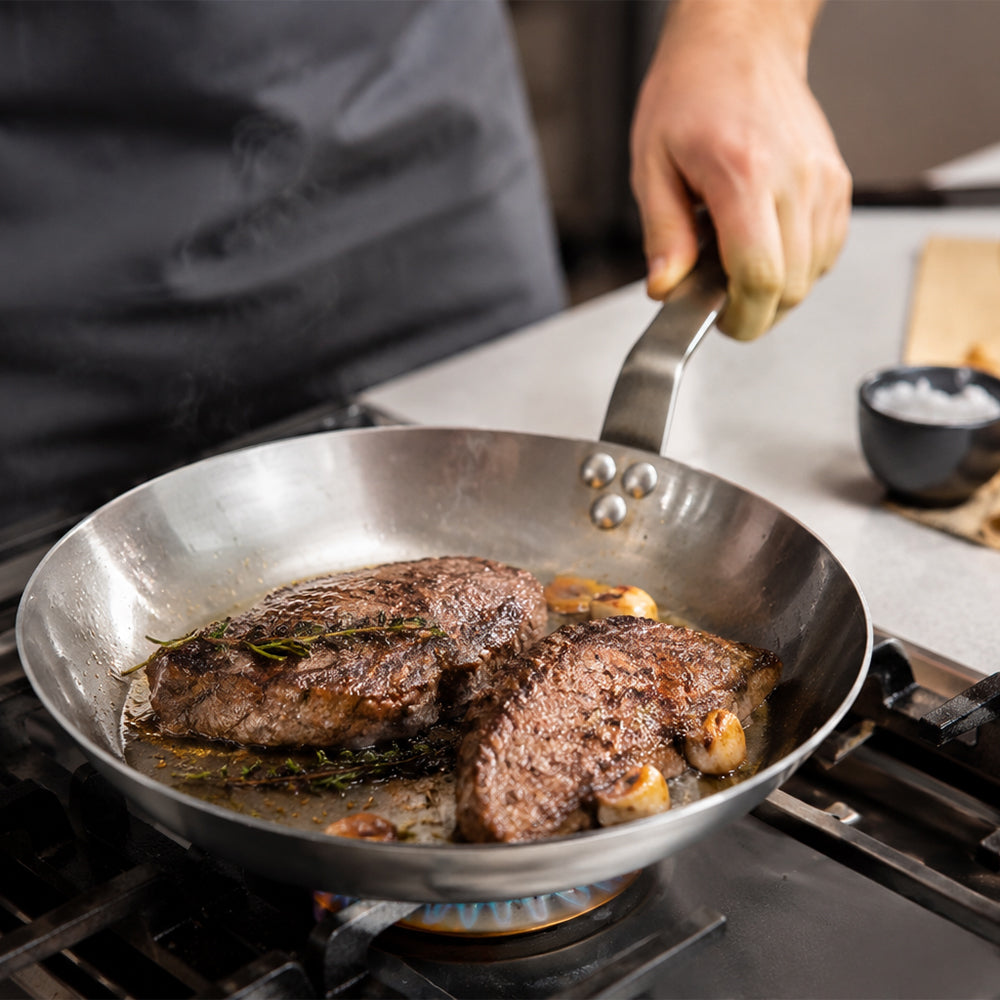
- Steaks and meat: excellent for intense browning and crust formation.
- Burgers: perfect when you want a well-coloured exterior and juicy interior.
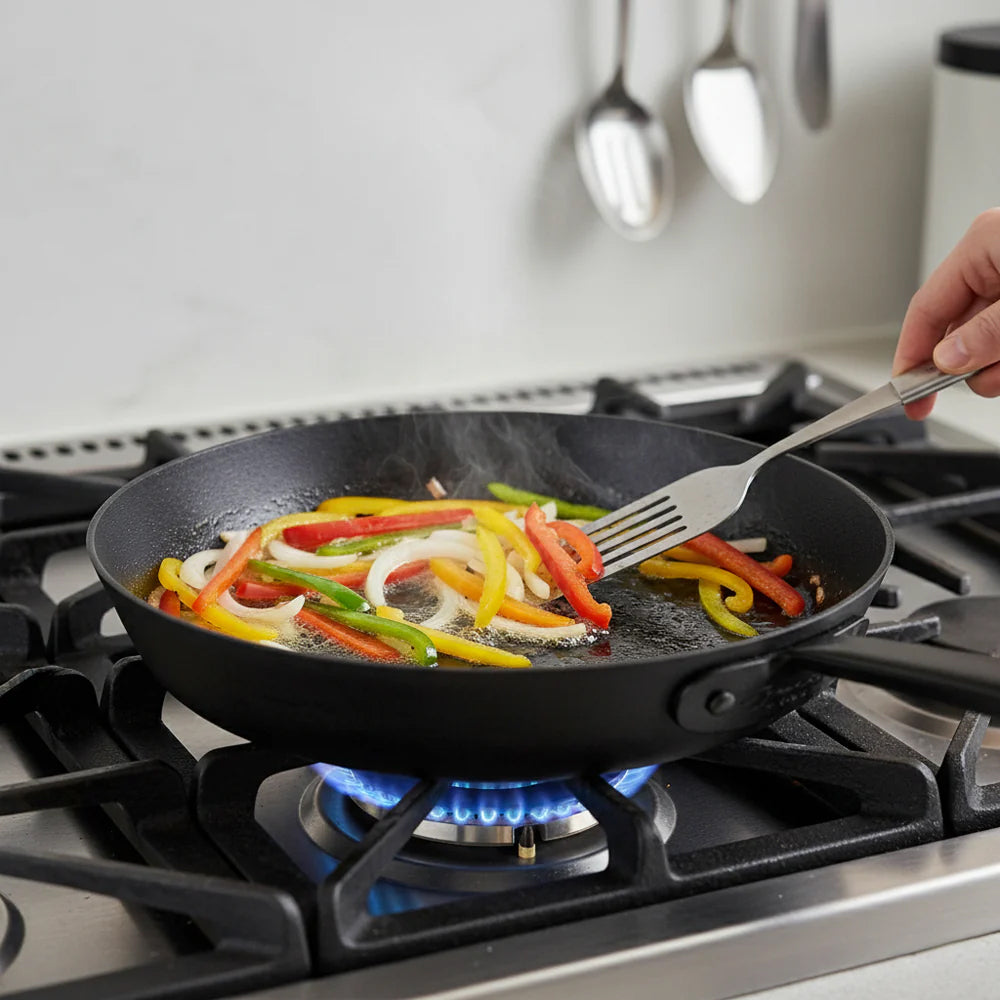
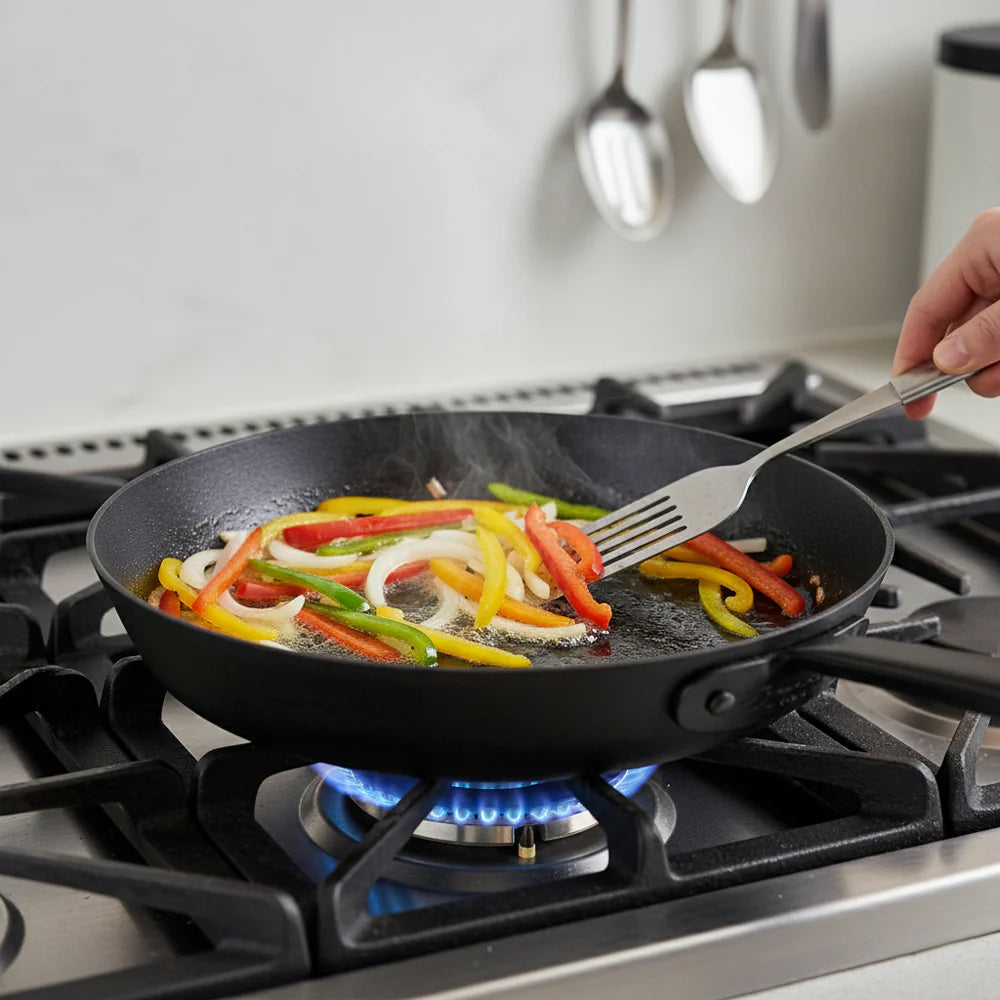
- Sautéed vegetables: peppers, mushrooms, onions and potatoes perform very well.
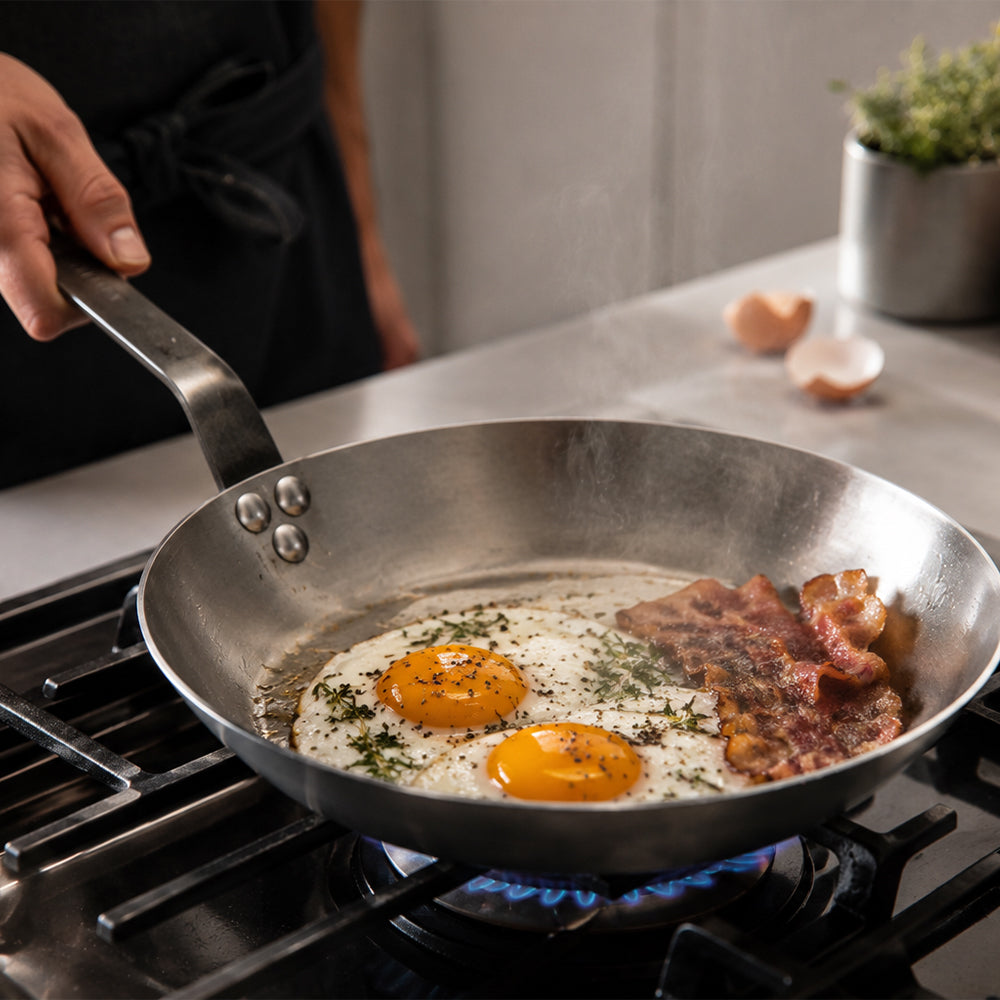
- Eggs: possible when the patina is well formed.
- Crêpes: the iron crêpe pan is a great classic.
- Frying: iron handles high temperatures well.
- Fish: suitable for quick cooking and well-browned surfaces.
To choose the most suitable size, you can evaluate the selection of iron pans, comparing diameters, shapes and heights based on your cooking habits.
Iron pans and induction
A very common question is: are iron pans suitable for induction? Many models are, but you should always check the product information. Iron is generally compatible with induction, but the diameter, base and construction of the pan can affect performance.
If you use an induction hob, always check the compatibility indicated on the product page. An iron pan can work well on modern hobs, but it must have a suitable base and a diameter consistent with the cooking zone.
Tips for induction
- Use progressive power, without always starting at maximum.
- Choose a cooking zone proportionate to the pan diameter.
- Avoid prolonged empty overheating.
- Dry the base well before placing it on the hob.
- Do not drag the pan over the glass ceramic surface.
Looking for an iron pan for induction, gas or glass ceramic hobs? Always check compatibility, thickness and shape: these details change cooking performance.
How to clean an iron pan
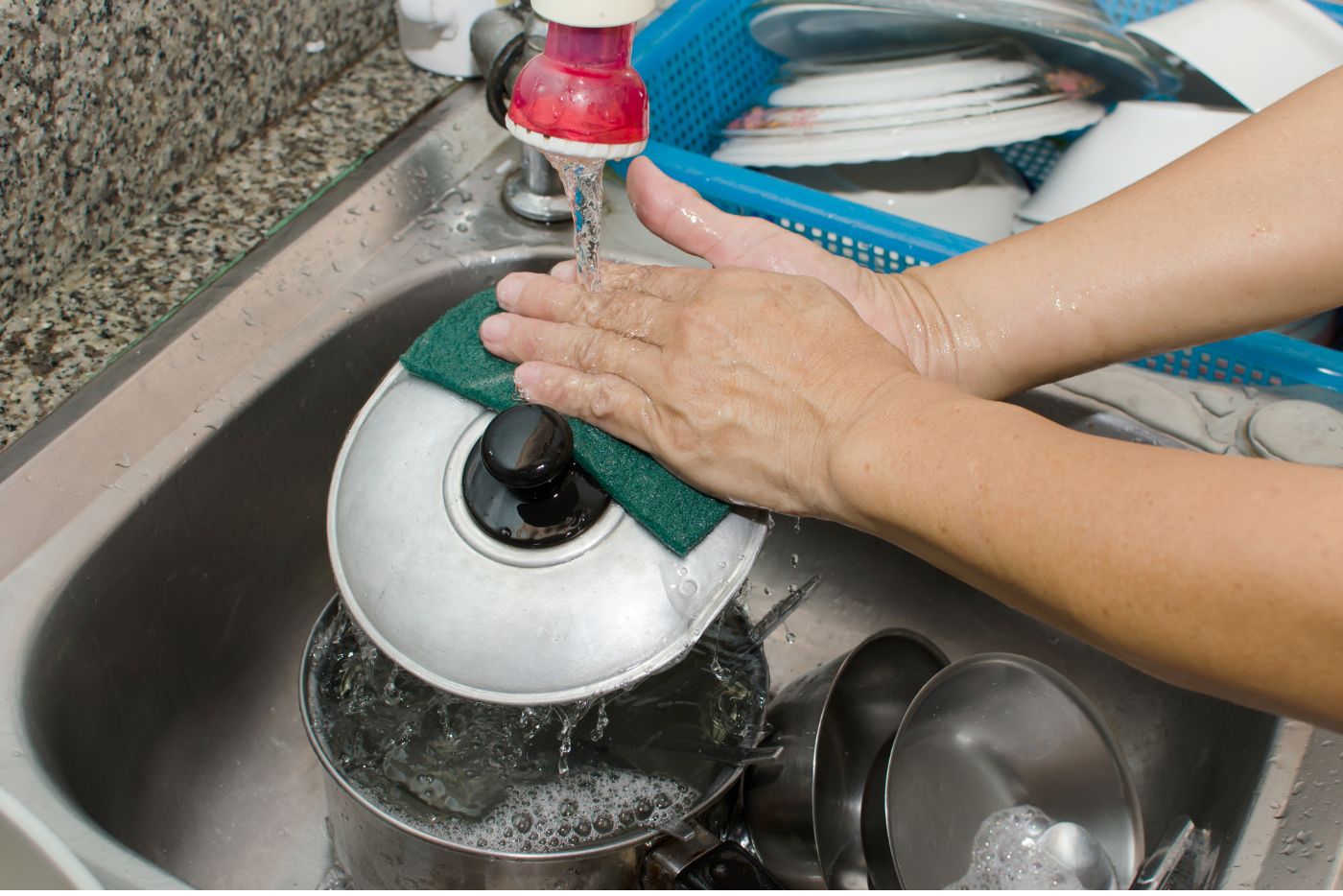
Cleaning is the part that worries people most, but in reality it is simple. The fundamental rule is one: no dishwasher. An iron pan must be washed by hand, dried immediately and protected from moisture.
After use, let the pan cool slightly. Then remove residues with hot water and a non-aggressive sponge. If needed, you can use coarse salt or a suitable spatula, avoiding unnecessary scratching of the patina.
Correct cleaning
- Wash the pan by hand.
- Use hot water and a soft sponge.
- Avoid aggressive detergents.
- Do not leave it to soak.
- Dry it immediately and carefully.
- Heat it for a few seconds on the stove to remove residual moisture.
- Apply a very light film of oil before storing it, if necessary.
What never to do with an iron pan
An iron pan is robust, but that does not mean it is indestructible. Its weak point is moisture, together with overly aggressive cleaning that can damage the patina.
- Do not put it in the dishwasher: it damages the surface and encourages rust.
- Do not leave it to soak: prolonged water contact is the enemy of iron.
- Do not use aggressive detergents: they can compromise the patina.
- Do not store it damp: drying and protection are essential.
- Do not expect immediate non-stick performance: the patina builds over time.
- Do not always use it for acidic cooking: tomato, wine and lemon can stress the patina, especially at the beginning.
Iron pan, non-stick, steel or cast iron: what changes?
Every material has a role. An iron pan does not automatically replace all the others, but it covers some specific needs very well.
| Material | Strength | Ideal for | Pay attention to |
|---|---|---|---|
| Iron | Browning, high temperatures, natural patina | Meat, vegetables, crêpes, frying, quick cooking | Maintenance, drying, no dishwasher |
| Non-stick | Practicality and use with little fat | Eggs, delicate fish, quick everyday cooking | Delicate coating and temperatures that are too high |
| Stainless steel | Hygiene, resistance, versatility | Browning, sauces, technical cooking | Requires temperature control |
| Cast iron | Heat retention and slow cooking | Meat, braising, oven, long cooking | Weight and heating times |
If you want to compare only this material, you can start from the category dedicated to iron pans.
How to choose an iron pan
To choose an iron pan well, start from what you want to cook. Do not buy only based on diameter: consider shape, height, thickness, handle and compatibility with your hob.
Diameter
A small pan is convenient for single portions, eggs or small preparations. A medium pan is more versatile. A large one is useful for meat, vegetables and larger cooking quantities, but requires a suitable heat source.
Height
A low pan is perfect for browning, sautéing and creating a crust. A high pan is more suitable for frying, larger preparations or cooking that requires containment.
Shape
The shape changes the use. An iron crêpe pan is designed for thin and even cooking; an iron wok works well with quick cooking and sautéed ingredients; a classic frying pan is the most versatile choice.
Handle
The handle must be stable, comfortable and consistent with the type of cooking. If you want to use the pan in the oven or on a grill, always check the handle material and the manufacturer’s instructions.
Compatibility
Always check whether the pan is suitable for induction, gas, electric or glass ceramic hobs. Compatibility is an important detail, especially if you use an induction hob or delicate surfaces.
Frequently asked questions about iron pans
Are iron pans non-stick?
They are not non-stick in the traditional sense. They do not have a synthetic coating, but develop a natural patina through seasoning and use. The more stable the patina, the better the performance.
How do you create the patina on an iron pan?
The patina is created by heating the pan with a thin film of oil. Heat bonds the oil to the surface and creates a protective layer. The process can be repeated several times and improves with use.
Should an iron pan be washed with detergent?
It is better to avoid aggressive detergents. If the patina is well formed, a little mild detergent can be used when needed, but daily cleaning should be simple: hot water, soft sponge, immediate drying.
Can iron pans go in the dishwasher?
No. Iron pans should not be washed in the dishwasher, because moisture, detergents and high temperatures can damage the surface and encourage rust.
Does an iron pan rust?
Yes, it can rust if it remains damp or is stored incorrectly. To avoid this, it must be dried immediately after washing and, if necessary, protected with a very light film of oil.
Is an iron pan suitable for induction?
Many iron pans are suitable for induction, but the product page should always be checked. Compatibility depends on the base, construction and manufacturer’s instructions.
What can you cook in an iron pan?
It is ideal for meat, burgers, sautéed vegetables, potatoes, crêpes, frying and quick high-temperature cooking. It is less suitable for acidic or very long cooking, especially if the patina is still young.
Is an iron pan or non-stick pan better?
It depends on the use. Non-stick is more immediate and convenient for delicate cooking. Iron is better for browning, developing crusts and working at high temperatures, but requires more care.
Conclusion: the iron pan is for those who want to cook better, not just more easily
Iron pans are not tools to buy if you want zero maintenance. They are pans to choose if you want more control, more heat, more browning and a surface that improves over time.
They require attention, especially at the beginning: seasoning, drying, no dishwasher and correct cleaning. In return, they offer intense, concrete and very satisfying cooking.
If you want to start or compare different sizes, visit the selection of iron pans on Alberoshop.it.
An iron pan is a true kitchen choice: it requires care, but gives back browning, control and satisfaction that few materials can offer.