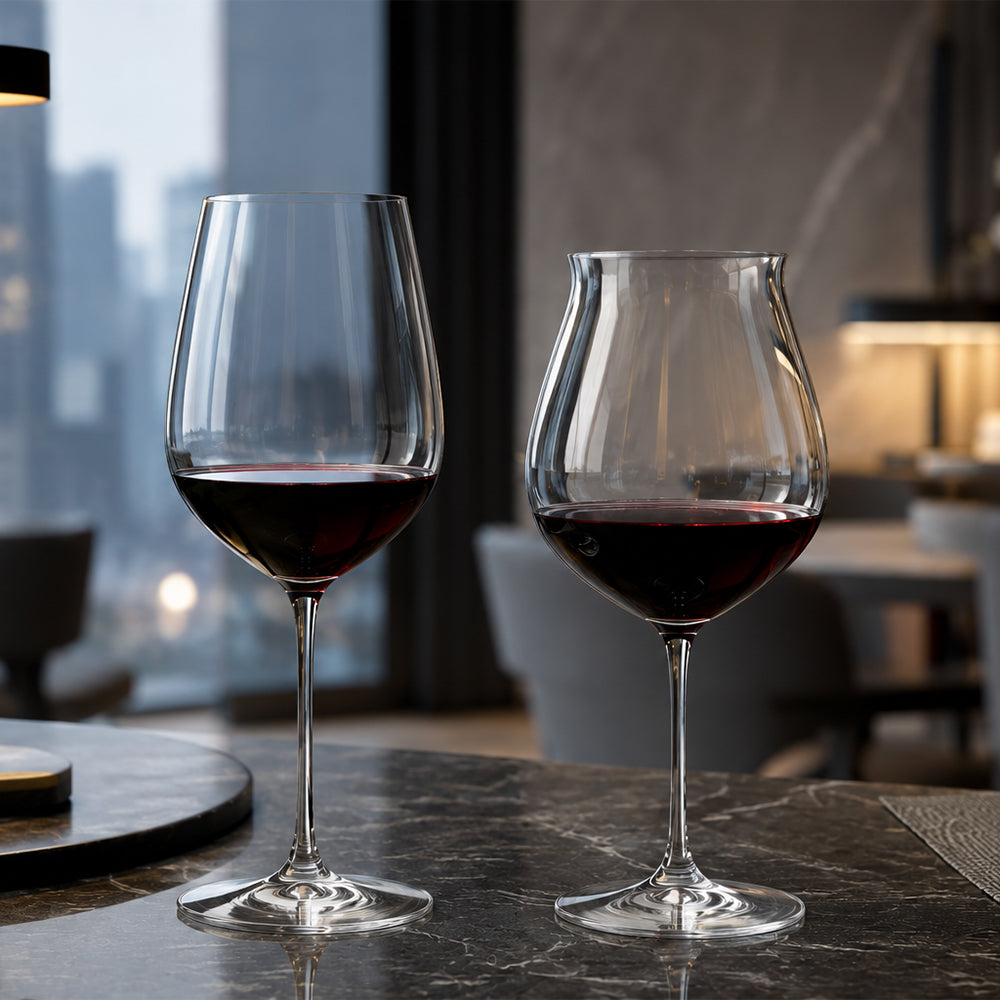
Bordeaux or Burgundy Glass? The Differences That Really Change the Tasting Experience
At first glance, they may look very similar: both have a long stem, a generous bowl and are mainly designed for red wine. Yet Bordeaux and Burgundy glasses meet different tasting needs.
The shape of the glass affects the surface area of the wine exposed to air, the concentration of aromas inside the bowl and the way the wine reaches the nose and palate. Choosing the right glass can therefore make a wine's aromas, structure and nuances easier to appreciate.
This does not mean that simply changing the glass makes a wine better. It means creating more favourable conditions for perceiving its characteristics.
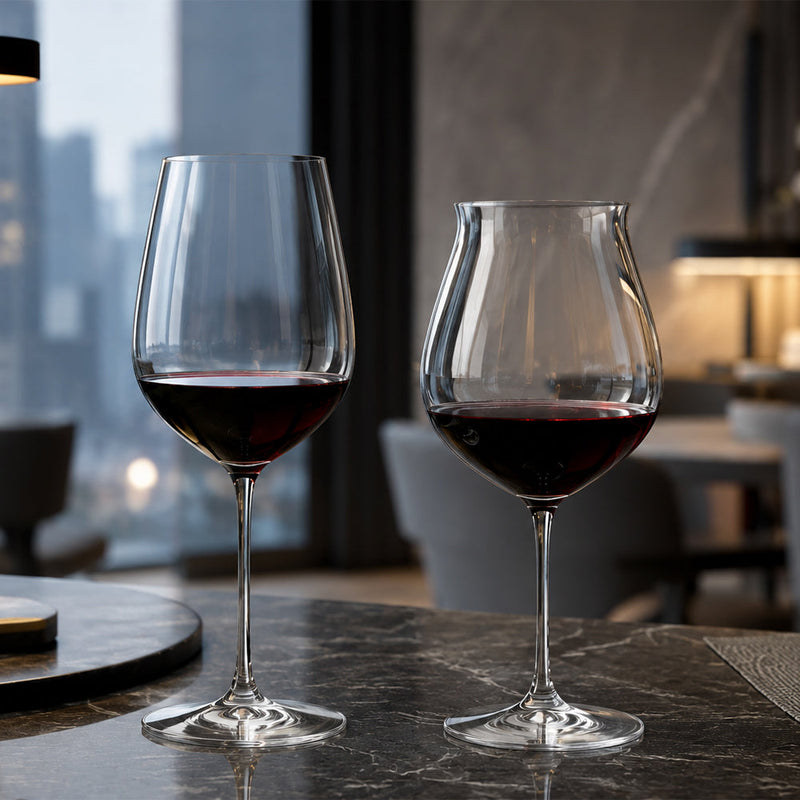
The fundamental distinction is simple: a Bordeaux glass is generally taller and more slender, while a Burgundy glass has a wider, rounder bowl. Much of their different behaviour during tasting comes from this geometric difference.
Bordeaux or Burgundy? It is not just a matter of appearance: the shape and volume of the bowl change the way the wine breathes and concentrates its aromas.
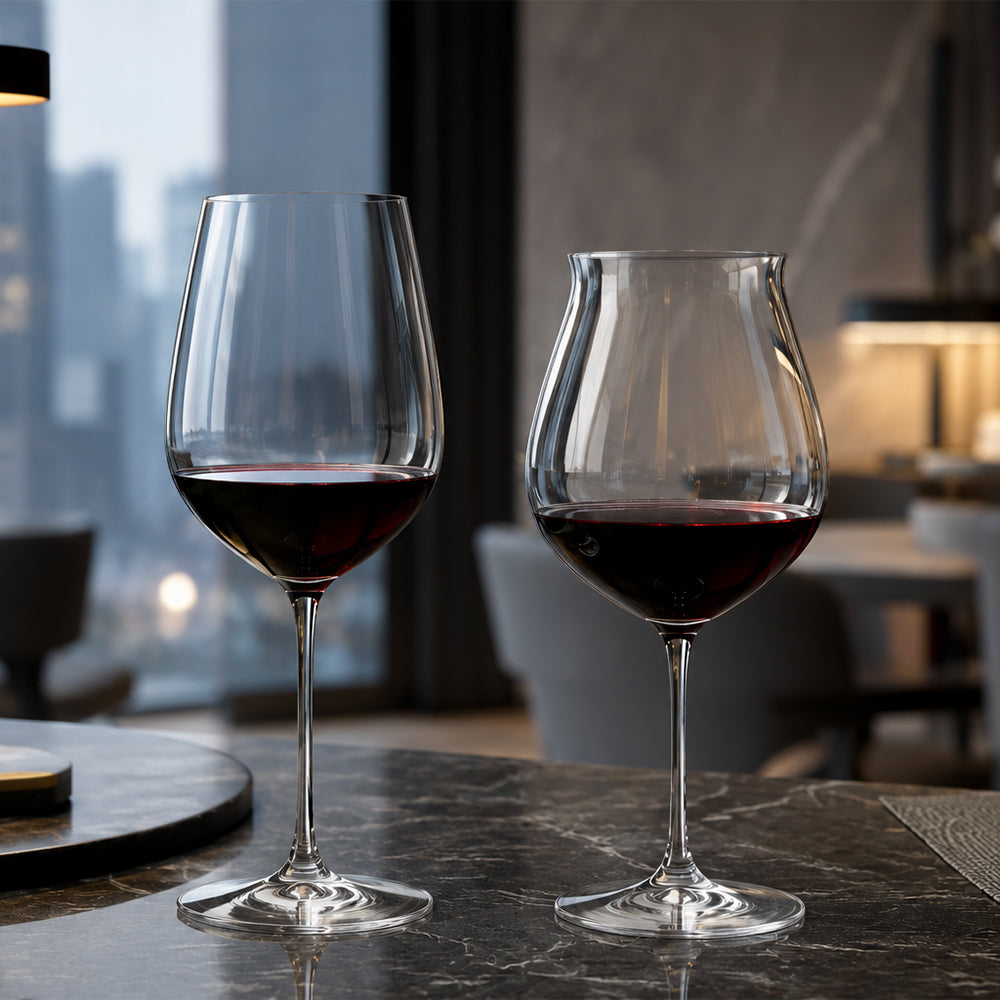
Why Are There Different Glasses for Red Wine?
Not all red wines have the same profile. Some focus on aromatic delicacy, others on structure; some display prominent tannins, while others are defined above all by their aromas, freshness and elegance.
The glass affects these very elements. A very wide bowl increases the wine's contact with the air, while a narrower shape can direct its aromas more effectively towards the nose.
The size, opening and curvature of the bowl therefore help shape the tasting experience. This is why specific glass shapes associated with particular styles of wine have emerged over time.
Among those designed for red wines, Bordeaux and Burgundy are probably the two most recognisable types.
Bordeaux Glass: What Does It Look Like and Which Wines Is It Used For?
A Bordeaux glass is generally tall, spacious and relatively slender. Its bowl gives the wine plenty of room to breathe, but narrows more noticeably towards the rim than a Burgundy glass.
This shape is particularly suitable for structured, intense red wines with a prominent tannic component.
Wines frequently associated with the Bordeaux glass include:
- Cabernet Sauvignon;
- Cabernet Franc;
- Merlot;
- Bordeaux blends;
- Bolgheri wines and Bordeaux-style blends;
- structured Supertuscans;
- other intense, full-bodied red wines.
The bowl has a more pronounced vertical profile than a Burgundy glass. This allows good oxygenation without exposing the wine to an extremely large surface area.
The result is a particularly versatile glass for tasting wines in which structure, concentration and tannins play a central role.
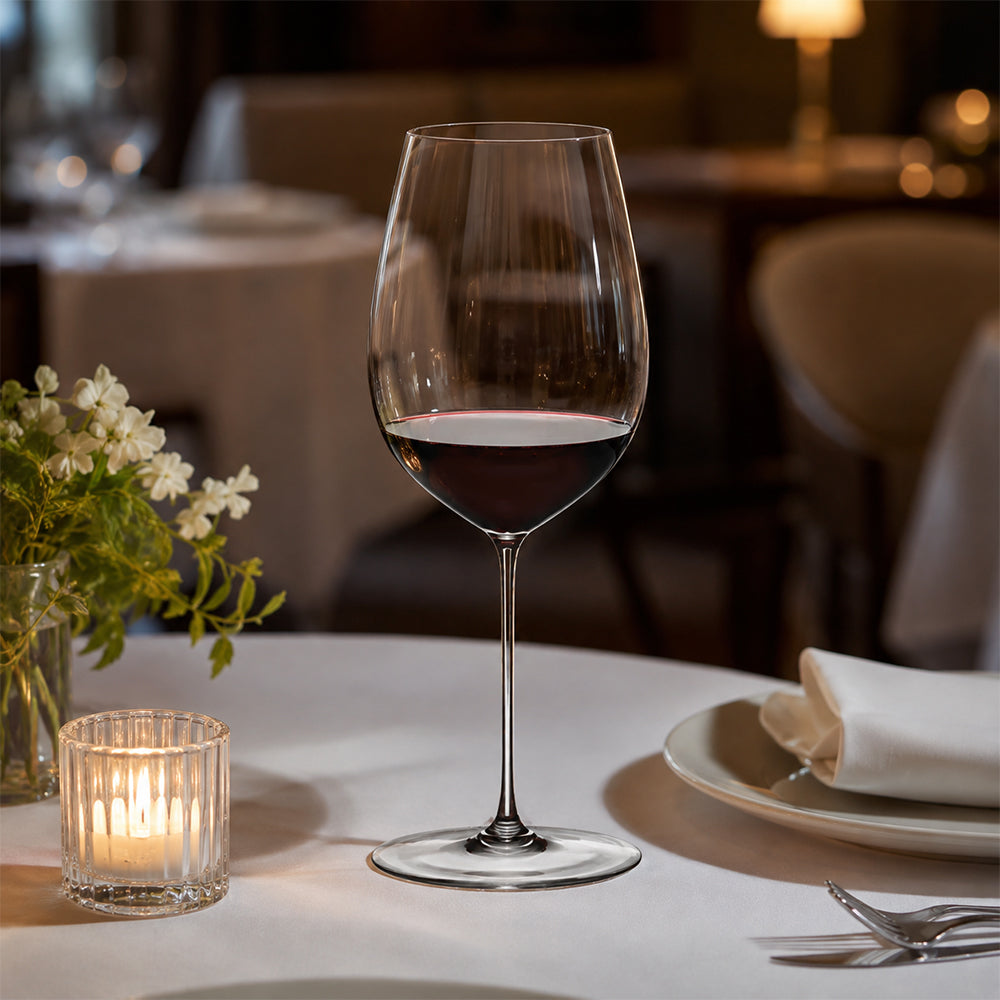
Tall, spacious and more slender: the Bordeaux glass is the one to know when serving Cabernet, Merlot and well-structured red wines.
Riedel Superleggero Bordeaux
The 89 cl Riedel Superleggero Bordeaux interprets the classic shape designed for great structured red wines with a generous bowl and a pronounced vertical profile.
A Bordeaux shape designed for anyone looking for a spacious, slender bowl dedicated to tasting great structured red wines.
Stölzle Lausitz Quatrophil Bordeaux
An alternative for those looking for a complete set is the 64.5 cl Stölzle Lausitz Quatrophil Bordeaux, available as a set of six and featuring a smaller capacity than larger tasting glasses.
Burgundy Glass: Why Does It Have Such a Wide Bowl?
The Burgundy glass is instantly recognisable by its silhouette. The bowl is very wide, rounded and bulbous, while the upper section narrows towards the rim.
The larger surface area allows the wine to come into contact with the air more easily. At the same time, the curvature of the bowl helps collect and direct the aromas towards the opening.
This shape is particularly interesting for wines in which aromatic complexity, finesse and olfactory nuances play a decisive role.
The Burgundy glass is frequently used with:
- Pinot Noir;
- red Burgundy wines;
- Nebbiolo;
- Barolo;
- Barbaresco;
- elegant and particularly aromatic red wines.
This does not mean that every Nebbiolo must be served in a Burgundy glass or that Pinot Noir cannot be enjoyed from another type of glass. The shape should instead be considered a tool for highlighting particular aspects of the wine.
Riedel Superleggero Burgundy
With a capacity of one litre, the Riedel Superleggero Burgundy clearly embodies the philosophy behind this type of glass: an exceptionally generous bowl designed to give the wine plenty of space.
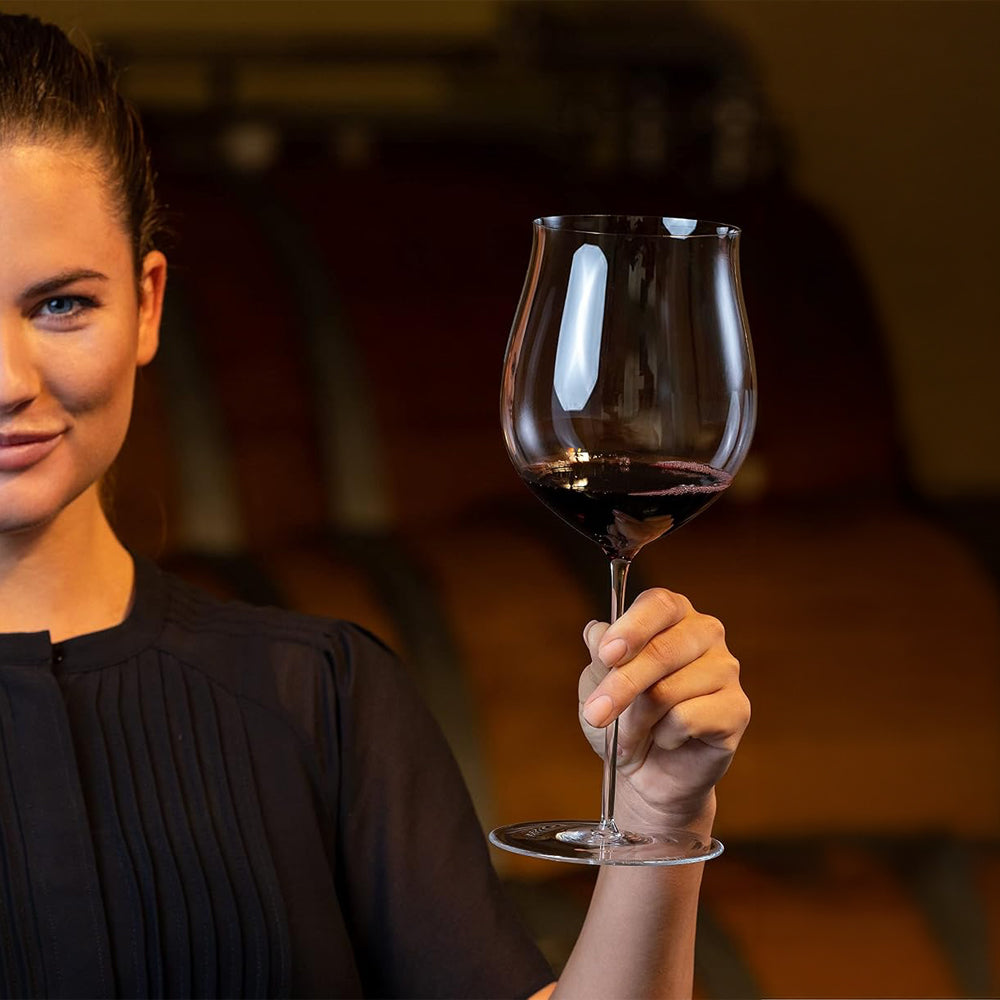
A one-litre bowl clearly shows what sets a Burgundy glass apart: plenty of space for the wine to open up and develop its aromatic profile.
Stölzle Lausitz Symphony Burgundy
The 71 cl Stölzle Lausitz Symphony Burgundy features the characteristic Burgundy shape in a set of six glasses, offering a practical solution for bringing this type of stemware to the dinner table.
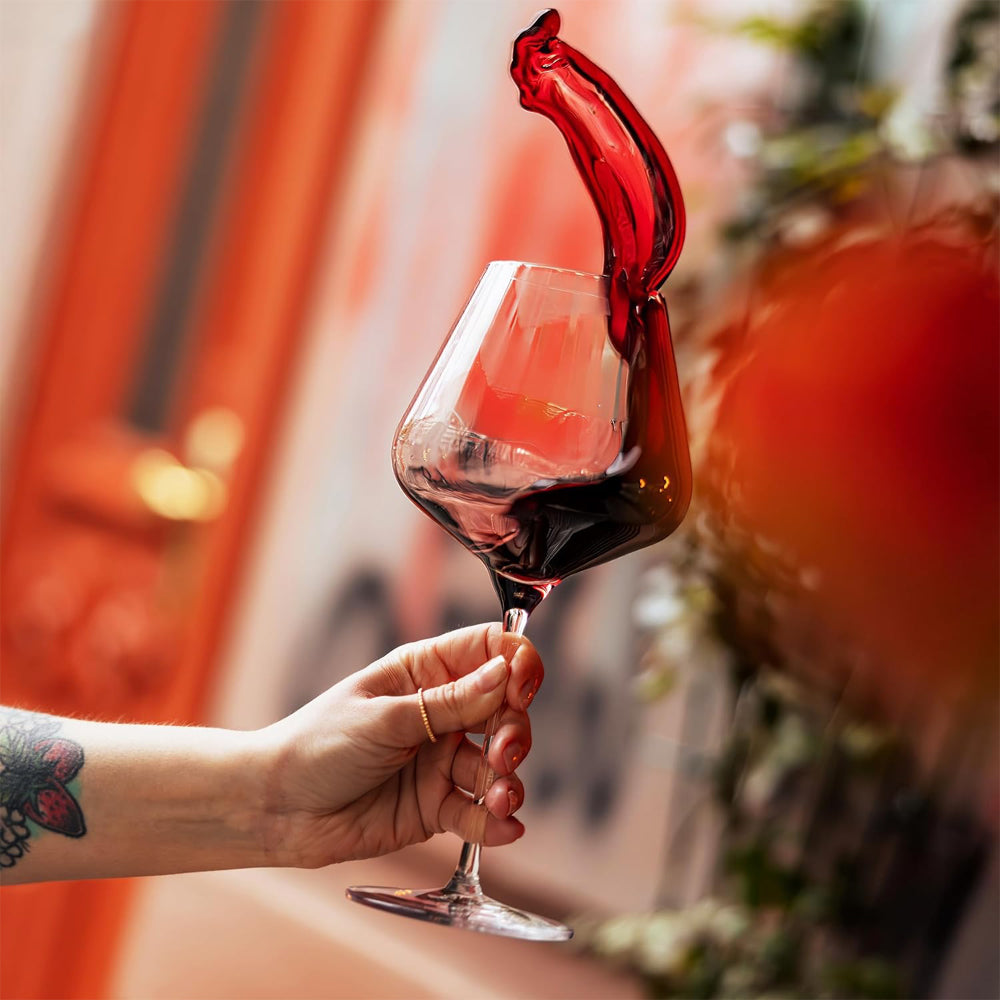
The Burgundy shape in a set of six glasses: a solution designed for serving aromatic, complex red wines as part of a coordinated table setting.
Spiegelau Definition Burgundy
Another option featuring this shape is the 96 cl Spiegelau Definition Burgundy, available as a set of four and characterised by a particularly generous bowl.
Bordeaux vs Burgundy: The Key Differences
| Feature | Bordeaux Glass | Burgundy Glass |
|---|---|---|
| Shape | Tall and slender | Wide and rounded |
| Bowl | Spacious but more vertical | Very wide and bulbous |
| Oxygenation surface | Generous | Particularly large |
| Characteristics enhanced | Structure, intensity and tannins | Aromas, complexity and aromatic elegance |
| Typical wines | Cabernet Sauvignon, Merlot and Bordeaux blends | Pinot Noir, Nebbiolo, Barolo and Barbaresco |
Bordeaux or Burgundy Glass: Which One Should You Choose?
If we wanted to reduce the choice to one simple rule, we could say that the Bordeaux glass favours structure, while the Burgundy glass provides more room for aromatic expression.
However, it is important not to turn this distinction into a rigid rule. Wine does not recognise the name printed on the glass packaging: what matters is the relationship between the wine's characteristics and the geometry of the glass.
A powerful, concentrated and tannic red can find excellent balance in a Bordeaux glass. A more delicate, complex wine rich in aromatic nuances may instead benefit from the large surface area provided by a Burgundy bowl.
What If You Only Want to Buy One Type of Glass?
In this case, start by considering the bottles you open most frequently.
If your wine cellar mainly contains Cabernet Sauvignon, Merlot, Bordeaux-style blends and structured red wines, a Bordeaux glass is probably the more versatile choice.
If you often choose Pinot Noir, Nebbiolo, Barolo, Barbaresco or other wines in which aromas and finesse play a central role, a Burgundy glass may be more suitable.
Anyone who enjoys exploring very different wine styles can, of course, use both shapes. This does not mean accumulating unnecessary glassware, but having two tools that behave differently.
How Important Is the Capacity of a Wine Glass?
One of the first things that may surprise you when looking at a professional tasting glass is its capacity. A Burgundy glass can hold close to or even as much as one litre, but this certainly does not mean it should be filled to the top.
The empty space is an essential part of how the glass works. It allows you to swirl the wine without spilling it and leaves enough volume for the aromas to develop and concentrate before reaching the nose.
This is why a large wine glass is normally filled only partially.
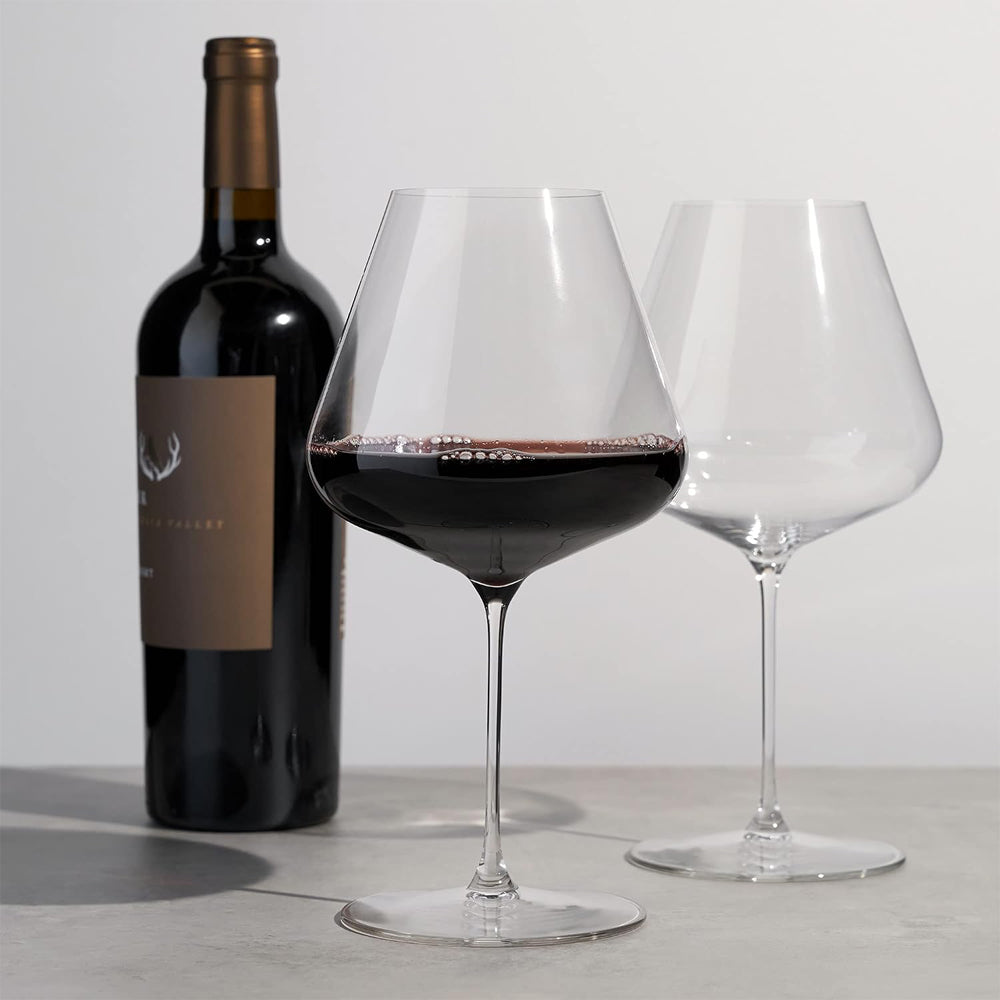
Zalto Denk'Art Burgundy: A Large Bowl for Aromatic Red Wines
Another example of the Burgundy philosophy is the 96 cl Zalto Denk'Art Burgundy, available as a set of two. Its generous capacity and large bowl surface clearly place it within the family of glasses designed for complex, aromatic red wines.
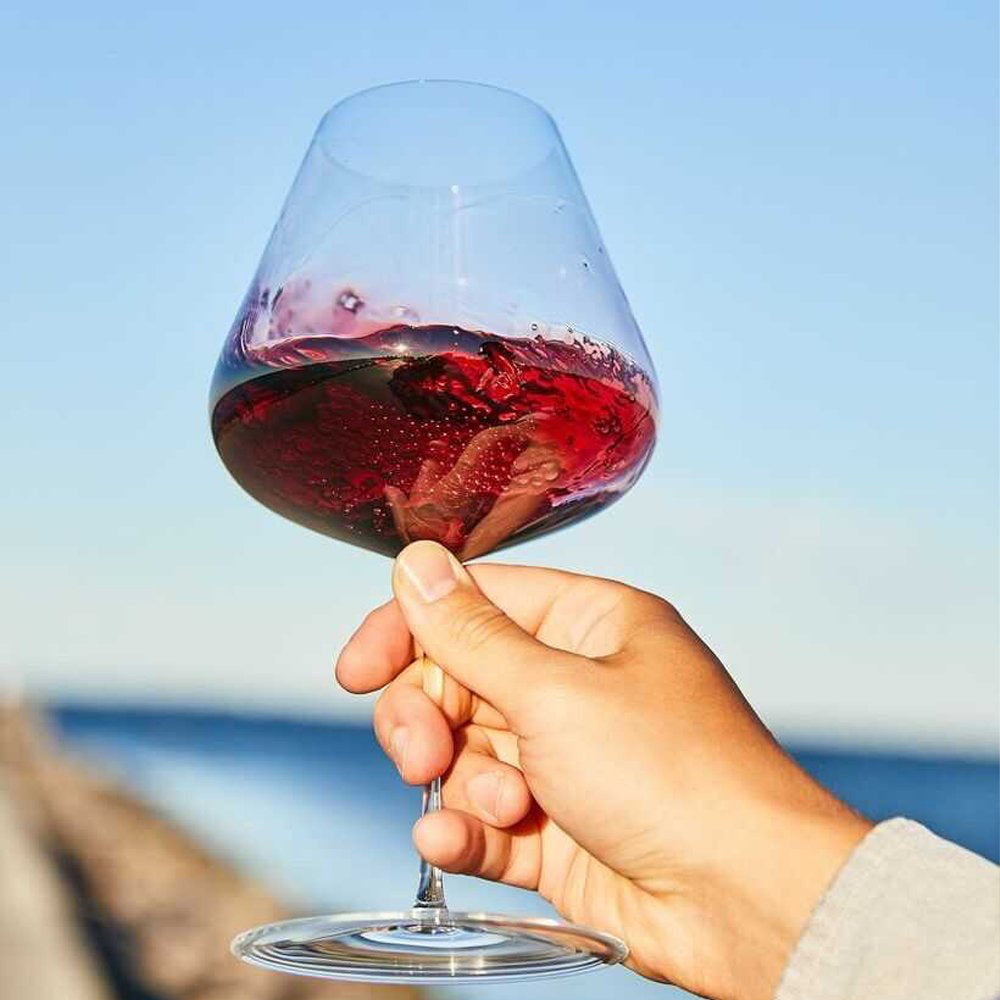
A large 96 cl bowl designed for aromatic red wines: Zalto Denk'Art Burgundy interprets the typically generous geometry of the Burgundy glass.
Which Glass Should You Use for Barolo and Nebbiolo?
A wide Burgundy-style bowl is often preferred for Barolo, Barbaresco and Nebbiolo. These wines can develop complex aromatic profiles and benefit from the space available inside the glass.
The large bowl also helps with wines that can change noticeably in the glass during tasting.
However, this should not be considered an absolute rule: serving temperature, the wine's stage of development and personal preferences remain equally important.
Which Glass Should You Use for Cabernet and Merlot?
Cabernet Sauvignon and Merlot are two classic examples of wines traditionally associated with the Bordeaux glass.
Its tall, generous shape provides enough room for oxygenation while maintaining a more vertical profile than the wide Burgundy bowl.
The same type of glass can be used for many structured red wines and blends in which intensity, body and tannins are central to the tasting experience.
Can a Wine Glass Replace a Decanter?
A large glass increases the contact between wine and air, but it does not perform exactly the same function as a decanter.
In the glass, oxygenation takes place with a limited amount of wine and directly during tasting. A decanter instead works with the entire contents of the bottle and can also be used to separate any sediment found in mature wines.
A large Bordeaux or Burgundy glass can therefore help the wine open up once poured, but it does not automatically make decanting unnecessary when it is genuinely required.
Mistakes to Avoid When Choosing a Red Wine Glass
- Choosing based only on capacity: the volume and shape of the bowl must be considered together.
- Overfilling the glass: the empty space is needed to swirl the wine and allow its aromas to develop.
- Assuming Bordeaux and Burgundy glasses are interchangeable: both can hold any wine, but they provide different tasting experiences.
- Using the grape variety as the only rule: the wine's structure, development and style can matter just as much as the grape used.
- Forgetting the temperature: even the best glass cannot compensate for wine served at the wrong temperature.
Frequently Asked Questions About Bordeaux and Burgundy Glasses
What Is the Difference Between a Bordeaux and a Burgundy Glass?
A Bordeaux glass is generally taller and more slender, while a Burgundy glass has a wider, rounder bowl. The former is often associated with structured, tannic wines, while the latter is used for complex and particularly aromatic red wines.
Which Glass Should You Use for Pinot Noir?
A Burgundy glass is generally preferred for Pinot Noir. Its very wide bowl provides the wine with a large surface area for contact with the air.
Which Glass Should You Use for Cabernet Sauvignon?
Cabernet Sauvignon is traditionally associated with the Bordeaux glass, which is particularly suitable for structured red wines with a prominent tannic component.
Which Glass Should You Use for Barolo?
A Burgundy glass is widely used for Barolo and Nebbiolo because its generous bowl encourages the expression of their complex aromatic profiles.
Should a Burgundy Glass Be Filled Generously?
No. Its large capacity is not designed to hold a larger serving of wine. A significant part of the bowl should remain empty so the wine can be swirled and its aromas can develop.
Can I Drink Bordeaux Wine from a Burgundy Glass?
Yes. There is no technical reason why you cannot. Using a different type of glass may, however, change the way the aromas, structure and alcohol are perceived during tasting.
Is It Better to Own Bordeaux or Burgundy Glasses?
It depends on the wines you drink most frequently. Bordeaux glasses are a particularly versatile choice for structured red wines, while Burgundy glasses are suitable when you want to give more room to complex, aromatic wines. Anyone who regularly tastes different styles may find it useful to own both shapes.
The Glass Does Not Change the Wine. It Changes the Way You Discover It
A great wine remains great regardless of the glass into which it is poured. But that does not mean the glass is irrelevant.
Shape, volume and opening change the conditions in which we observe, smell and taste the wine. A Bordeaux glass and a Burgundy glass therefore offer two different ways to enhance the tasting experience.
The choice should not become a rigid rule. Instead, it can be an opportunity to experiment: pouring the same wine into two different glasses is one of the simplest ways to understand how much the shape of the glass can influence perception.
Once you have chosen the glass, the true protagonist naturally remains the wine. In our selection of red wines, you can explore different labels and styles to put your glassware to the test.
The most interesting test? Pour the same wine into a Bordeaux and a Burgundy glass, wait a few minutes, then compare the aromas and sensations. The wine is identical. The experience may not be.